Marketing Deal Offers

  • Subscribe to our RSS feed.
  • Twitter
  • StumbleUpon
  • Reddit
  • Facebook
  • Digg
Showing posts with label enterprise marketing management. Show all posts

Thursday, 19 September 2013

New Study: Three Types of Customer Data Platform Address Cross-Channel Marketing Needs

Posted on 17:57 by Unknown
My detailed study of Customer Data Platforms should be released next week. Now that the information is assembled, I can at last pull back and get a good overview of what I’ve found.

Perhaps the most interesting discovery has been that the CDP vendors cluster into three main groups.

• B2B data enhancement. These build a large reference database of companies and employees, which they match against records imported from their clients. They generally return corrected and enhanced data and lead scores based on models built from the client’s customer files. Their reference databases are built from multiple public, commercial, and proprietary sources, and are assembled using sophisticated matching engines. Most also perform their own scans of Web sites and social networks to extract sales-relevant information such as technology use and changes that suggest buying opportunities. These vendors vary considerably in the data they return, ranging from lead scores only to recommended marketing treatments to full customer profiles. Some also provide prospect lists of companies that are not already in the client’s own database. CDP vendors in this group include Infer, Lattice Engines, Mintigo, and ReachForce.

These systems compete with non-CDP products which also add or enhance prospect records but do not maintain a database with their clients’ customers. These include Web scanning systems such as InsideView, LeadSpace, and SalesLoft, and general data compilers including NetProspex, Demandbase, Data.com, ZoomInfo, and OneSource. The predictive modeling features also compete to some degree with end-user-oriented marketing analytics and modeling software such as Birst, GoodData, Cloud9 Analytics, AutoBox, and Predixion Software. Data cleansing competitors include services from firms such as D&B, as well as data management software for technical users such as Informatica, Experian QAS, and FullContact.

• Campaigns. These systems build a multi-source marketing database from the client’s own data and either recommend marketing treatments to execution systems or execute marketing campaigns directly. These are primarily used for consumer marketing although they also have B2B clients. Most have sophisticated matching capabilities. This group includes Silverpop with its Universal Behavior feature, NICE’s Causata, AgilOne, and RedPoint.

This group competes with conventional consumer marketing automation products, which provide similar campaign management abilities but lack the CDPs' database flexibility, database management, and customer matching features.

• Audience management. These systems build a database of customers and their responses to online display advertisements. They then build models that predict the customers’ probability of responding to future advertisements and provide recommendations for how much to bid and which content to display. These systems perform the same basic functions as standard online audience management systems (Data Management Platforms, or DMPs) and provide the same very quick responses needed for real time bidding (usually under 100 milliseconds). The major difference is that they also recommend messages in other channels, such as Web site personalization or email campaigns. Like DMPs, they work primarily at the Web cookie level, can link cookies known to relate to the same customer, and can be linked to actual customer names and addresses in external systems. This group includes IgnitionOne, [x+1], and Knotice.

This group overlaps with recommendation and ad targeting engines and DMP systems. Those products provide similar functions but do not track identified individuals and are often limited to single channel executions.

Given that each group addresses a different business need, you might wonder why I think they should all be lumped together under the CDP label. Quite simply, it’s because they are all addressing a portion of the same larger problem, which is how marketers can get a complete view of their customers and use that view to coordinate treatments across channels. What marketers truly need is a combination of the features from each group: data enhancement from external sources, for consumers as well as B2B; sophisticated customer matching and treatment selection; and integration of online advertising audiences with traditional customer databases. Each of these systems has the potential to grow into a complete solution, and the normal dynamics of software industry growth will push them towards pursuing that potential. So I expect the categories to overlap increasingly over the next few years and eventually merge into complete Customer Data Platforms as I envision them.

Incidentally and tangentially related: I'll be giving a Webinar with ReachForce on October 2 on Data Quality for Hipsters, a name that started as a joke but does make the point that data quality is essential for cutting-edge marketing.  YOLO, so you might as well attend.  I'm already working on the mustache.


Read More
Posted in big data, customer data management, customer data platforms, customer data warehouse, customer information, data quality, dmp, enterprise marketing management, marketing database | No comments

Friday, 31 May 2013

Neolane Interaction Tightly Integrates Real-Time and Outbound Marketing Campaigns

Posted on 07:02 by Unknown
As I mentioned last week, there haven’t been many new B2C marketing automation products in recent years. But this doesn’t mean the industry has been stagnant. New developments have come from established vendors who are steadily expanding their products.

Neolane has been one of these, growing from its roots in email to encompass other outbound and inbound channels, and more recently with a slew of social and mobile marketing features. One of its offerings, originally launched in 2009, is its real-time interaction manager, Neolane Interaction.


Interaction performs the same basic functions as other interaction managers: it receives a request from an external touchpoint that is engaged with a customer, selects the best treatment, and returns the recommendation to the touchpoint.  However, it differs in several key details:

- it supports both batch (outbound) and real time interactions. This is unusual, because efficient processing usually takes different data structures and methods for batch vs. real time. But Neolane cites one customer delivering 10,000 Web recommendations per minute and another sending ten million customized emails per week, so it has apparently found a way to handle both. Supported channels include email, Web, social, mobile, call center, point of sale, and SMS.

- it uses the same offer library for real-time and outbound campaigns. This means that offers can be used interchangeably in both types of campaigns – something that considerably simplifies program design and analysis. Each offer can include separate content for the different channel formats. Users specify which offers are available in which channels, to ensure an offer isn't recommended where it shouldn't be.

- it draws data from the Neolane marketing database as part of its offer selection rules. This is different from most interaction managers, which query external systems rather than maintaining their own persistent customer database. (Neolane could also do external queries.)  Again, this approach raises a technical eyebrow, since traditional marketing databases are not structured for real-time interactions. But Neolane seems to pull it off.  I suppose it helps that Neolane can attach to any data structure, so clients who want real-time interactions presumably build a real-time-friendly database.

- it supports both anonymous and identified customer interactions. Most real-time interaction managers make customer-specific recommendations, although Web recommendation engines are often designed for anonymous visitors. It makes sense for Neolane to support both, again serving the greater goal of providing one marketing system to meet as many needs as possible.

These items all grow out of the fundamental fact that Interaction is a module within the larger Neolane system, rather than a separate product. Other features of the system are more typical of dedicated interaction managers:

- eligibility rules for each offer. There are also eligibility rules for offer categories, which save effort by applying the same rule to multiple offers.

- offer arbitration (i.e., choosing which of several eligible offers to return). Offers can be ranked using fixed weights assigned to each offer; by calculating weights with a formula that draws on customer data; or with an unusual “autolearn” function that adjusts the weights to ensure that the offer will be seen. The system does not incorporate any of predictive modeling, although model scores built elsewhere could be used in weighting formulas.

- each recommendation is independent of a larger dialogue flow. At best, marketers wishing to deliver a sequence of treatments could create eligibility rules that check for previous treatments. This limitation is typical of real-time interaction managers.

- a simulation function that estimates how often each offer would be presented to an audience with specified characteristics. This helps marketers see the results of different eligibility rules and offer weights, which can be difficult to estimate in advance. It’s found in some but not all interaction managers.

The downside of Neolane’s approach is that customers who only want an interaction manager must still purchase the full Neolane system. This isn’t necessarily cost-prohibitive: the company says its average deal for the base system plus Interaction is around $350,000. Actual fees depend on the number of interactions processed. The system is available for on-premise, hosted, or “hybrid” deployment (on-premise installation with Neolane-hosted email delivery). Neolane says about 60% of its clients choose an on-premise option.

To end on a positive note: Neolane sold 22 new Interaction installations in 2012, up from 17 the year before. This makes it one of the company’s fastest-growing products.
Read More
Posted in campaign management software, enterprise marketing management, neolane, real time interaction management | No comments

Wednesday, 22 May 2013

Selligent Brings a New B2C Marketing Automation Option to the U.S.

Posted on 18:20 by Unknown
I’m writing this post on my old DOS-based WordPerfect software, to get in the proper mood for discussing business-to-consumer marketing automation.* The late 1990’s were really the last time we saw major innovation in the B2C market, when vendors like Unica and Aprimo released their then-innovative systems to create lists for direct mail and, somewhat later, email campaigns. Since then, the number of independent B2C marketing automation vendors has actually dwindled** as major and not-so-major products were purchased by larger companies to bundle into integrated suites or just use internally. Even the leading survivors, including Neolane (founded 2001) and RedPoint (founded 2006) have their roots in traditional outbound campaigns, although they now support Web, social, and real-time interactions to varying degrees.

Still, I’m excited as an entomologist with a new beetle*** to see another vendor in the space. Selligent  isn't brand new – the company was founded in 2000 and its marketing automation system dates back about six years – but the company says it was built from the ground up to manage real time interactions. A deep dive left me seriously impressed.

The first thing you need to know about Selligent is that while it’s new to the U.S. market, it is well established in Europe, where it serves 400 brands in eleven countries. It’s particularly strong among retailers and publishers. This experience translates into the types of refinements that can only be based on client demands. To pick a couple more or less at random, these include a matching engine that selects among hundreds of news articles to find those most relevant to individual subscribers (a sort of dynamic-content-on-steroids that’s important to publishers) and tools to manage product give-aways and rewards for viral sharing (important for retailers). They also include standard B2C features that are still lacking in most B2B products, such as precise control over user access to specific pieces of content, data, and system functions; planning hierarchy to schedule and budget for multiple marketing programs in separate organizations; and rules to limit the number of marketing messages each customer receives.

The basic architecture of Selligent is typical for B2C marketing automation systems. That is, it attaches a marketer-friendly interface for data access and analytics to an externally-built customer database. Brave users can add new fields and even entire data tables, and can import external data directly into the system. But the data must be matched on a fixed identifier, such as account number or email address, or combination of fixed identifiers. Data standardization, identity resolution, and change history (such as new vs. old mailing address) are largely handled elsewhere.

Selligent also uses the familiar flow chart interface to design its campaigns. Beyond the superficial graphics – where Selligent is no better than average – it takes a connoisseur to spot the subtle differences among these implementations. Selligent does hit a number of fine notes, including A/B tests, option to reunite branches after a split, mix of data segmentation with marketing outputs in the same flow, ability to enter and leave flows at multiple points, option to direct customers to other flows, separate schedules for individual objects within a flow, and automated warnings of incomplete designs.  Did I mention hints of almond?


But the big differences are not visible. For example, you see that a campaign flow can include a survey.  What you can't see is that surveys go beyond progressive profiling (replacing questions as they’re answered) to include branches based on customer profile and in-session answers, ability to re-ask questions after a specified period, asking questions in different languages but storing answers in one language, using the same question on multiple surveys and storing all answers in a single location, and providing statistics on completion rates, average time to complete, and which pages have the most validation issues and drop-outs. This is definitely above average for survey features in marketing automation tools, and more than competitive with many dedicated survey systems.

Selligent flows also support business processes that include external steps, such as manual review of an order. To do this, the system assign a “state” to a customer and then reacts differently within the flow based on that state. A separate “FrontOffice” module provides an interface for call center and other agents, and can apply rules to route customers to specific centers, teams, and agents. The system supports Microsoft’s computer-telephone integration (CTI) features, but doesn’t integrate with other phone systems. Basic campaign flows can send data to external systems via file exports or by calling an Application Program Interface (API).

As these examples may suggest, one key theme for Selligent flows is tight integration across all channels. Perhaps the best example of this – and something I’ve looked for in many other systems and never found – is that its flows can control movement from one Web page to another. That may not sound unique, but if you look closely at other marketing automation flows you’ll see they typically end with serving up a Web form and then start independently with events triggered by completion of a form. All well and good, but it means you need to build a separate flow for each step in a multi-stage interaction. Even the real-time interaction management systems treat each recommendation independently, so the only way to create a multi-part dialog is to build separate campaigns or to build one campaign with complex qualification rules that test for completion of each dialog step before moving to the next. Both approaches involve much painstaking labor and room for error. Selligent, on the other hand, lets users connect one page to another on the flow diagram; the system then automatically embeds URL links to make the connection. I’ve had three clients ask me for this in the past year alone.

Back in the realm of the normal, Selligent also offers a graphical email/Web page designer that supports the usual design features, personalization, dynamic content.  More impressive, it has integrated multi-variate testing and lets users convert an email to a Web page, or vice versa, by pushing a single button. A single email or Web page can be shared across multiple campaigns with  changes to the master object automatically deployed everywhere it’s used. Selligent doesn’t automatically store previous versions of contents as they’re edited and doesn’t provide formal check out/check in to avoid conflicting edits. But users can save and restore backup copies.  The system also keeps an audit trail of who made changes and issues a warning when someone opens a document that someone else is already editing.

Reporting in Selligent is based on information gathered from each object in a campaign flow. The specific data depends on the nature of the object.  Users can also insert objects that capture specific information such as the number of people who have passed through. There are no standard campaign reports; instead, users build their own reports by assembling the object-level information. I found this a bit odd, but Selligent said each client wants something different and prefers to create their own. The vendor has recently added a Business Intelligence module, using Quiterian (recently purchased by Actuate and renamed BIRT Analytics) which provides ad hoc analytics and visualization. Data is exported from Selligent to the Quiterian database, but this happens automatically and selections made in Quiterian are automatically copied back to Selligent as segments for marketing campaigns.

Selligent does have its weaknesses. It doesn’t easily support some advanced queries and splits, such as finding the top 100 customers per store or selecting the highest-spending person per household. It has no built-in predictive modeling or integration with third-party modeling systems, although it can easily import externally-created model scores. Somewhat surprisingly, it lacks geographic radius selections (although Quiterian has these) and doesn’t adjust sending dates or hours for the local holidays or time zones. Apparently it hasn’t needed these in Europe, where clients run separate campaigns for individual countries, countries don’t span time zones, and local units, such as provinces, are small enough to make distance-based selections unnecessary. This will surely change as it adapts to the U.S. market.

Pricing for Selligent is based on modules used and number of unique customers. There is no separate charge based on message volume or number of users. The system can be purchased as a vendor-run service, deployed on-premise, or deployed locally with Selligent executing the emails. Price for the base system starts around $6,000 per month for 250,000 contacts.  The vendor says its cost is often equivalent to what high-volume clients are paying for email alone.  As in Europe, Selligent expects to sell primary through marketing agencies and service providers in the U.S. market. 


________________________________________________________________________________
* Not really. I tried, but WP.exe won’t run on my current computer. Too many bits or something.

** See my list of mid-tier B2C systems.  Seven of the twelve listed are now owned by someone else.

*** Probably more excited. New beetles are pretty common.  Nearly 250 have been discovered this year alone in New Guinea  and Central/South America.
Read More
Posted in b2c marketing automation, campaign management software, digital marketing systems, enterprise marketing management, selligent | No comments

Monday, 20 May 2013

Silverpop Announces Universal Behaviors to Provide Better Cross Channel Customer Experience

Posted on 14:44 by Unknown
At their annual Amplify conference last week, Silverpop unveiled the culmination of a two year project that conveniently matches the Customer Data Platform (CDP) concept I’ve been describing for the past month. While the timing is just coincidental, Silverpop’s Universal Behaviors provide more evidence that a new breed of system is emerging.

Silverpop’s new features load customer behaviors from all sources into a central database, match identities to create a unified customer view, and make the resulting information available for real-time, automated interactions across all channels. The central database and cross-channel treatments are two of the three capabilities I’ve defined for a Customer Data Platform. Silverpop falls short on the third CDP function, which is integrated predictive modeling.  But it has partners who fill that gap.

Many CDPs have been quietly maturing for several years.  Silverpop's two-year gestation cycle is a good example.  I can't say precisely why so many are emerging more or less simultaneously, but suspect a combination of business conditions and ever-more-urgent marketer needs.  The long-term drivers are clear: more marketing channels make customer attention harder to attract, spread behavior across different media, and require coordinated contacts across channels. As a result, marketers need a unified customer database, unified campaigns, and way to deliver messages across whatever channels customers use now or in the future. This is what they get from a CDP.

It’s less surprising to see another CDP system than to see it coming from Silverpop.  After all, Silverpop’s twin heritages in B2C email and B2B marketing automation both use simple data models: flat lists for email and basic lead/contact/account tables for B2B marketing automation. Both types of systems traditionally merge customer data using only email address.  Neither build a company's primary marketing database or shares data with external systems. So its quite unexpected to see Silverpop ingest data from any source, cross-reference any set of individual identifiers, offer access to the data, and send messages for delivery by other systems.

So how do Universal Behaviors work?  Each Behavior is first defined in Silverpop with a fixed set of attributes. Source systems then capture Behaviors and post them via an API to Silverpop.  They are stored in MongoDB, a “NoSQL” database that supports high input volumes and multiple record structures.  This is another departure for Silverpop, which uses the Oracle database in its core systems.

Behaviors include whatever customer identifiers the source system can provide: email address, cookie ID, phone number, account number, etc. Silverpop uses matches from external systems to link all identifiers associated with an individual: for example, a Web transaction might include cookie ID and email address, while an email could contain email address and account number.  Silverpop could later take a Behavior with any one of those identifiers and associate it with the same individual.  But there are limits to Silverpop's customer integration powers: it doesn’t do “fuzzy” matching to merge similar identifiers or import third-party reference databases that contain such links.  I'm beginning to see those capabilities are specialties that are not necessarily core features of a CDP because they're best purchased from third party vendors.

The initial release of Universal Behaviors, set for July, will support predefined Behaviors from ArgyleSocial social listening, Webtrends Web site behaviors, Digby location-based marketing, Invodo video, and several as-yet unannounced vendors, as well as Silverpop’s own location-based and SMS offerings. It will later add more partners, provide a system development kit (SDK) for mobile apps, and eventually allow any company to build its own connectors.

Once Universal Behaviors are loaded into Silverpop, they become available within the system for queries, program triggers, rules within programs, dynamic content, personalization, scoring, and analysis – pretty much anything that could be done with standard Silverpop data.  Program outputs such as messages and lists can be pushed in real time to external systems to manage interactions.

Silverpop has also created native integrations with Adobe and Episerver Web content management systems.  These let those systems submit a visitor ID to Silverpop and receive Silverpop data to use in dynamic content and personalization. Connectors for other CMSs will be added as clients request them. Clients could also write their own integrations using a published Silverpop API or use tags to display Silverpop-generated content on any Web page. Currently, CMSs can access selected customer attributes but not the Universal Behavior database itself.  Silverpop plans to provide full data access in the future.

The mobile app SDK will go even further, allowing apps to execute Silverpop functions such as adding a customer to a program or sending an email.  This is in addition to the standard features of submitting Universal Behaviors, reading Silverpop data, and rendering Silverpop-generated content.

The critical point in all this is that Silverpop will integrate other customer-facing systems instead of only executing interactions itself.  The integration includes sending data to Silverpop, reading data within Silverpop, and receiving Silverpop marketing treatments.  In other words, the role of Silverpop shifts from delivering customer treatments to helping other systems find the best treatments to deliver. Of course, Silverpop still retains its original execution capabilities for email and some other channels.  But it’s perfectly conceivable that a client could hook the new Silverpop features to someone else's email delivery system (not that anyone at Silverpop mentioned the possibility).

This separation between a central data-and-decision platform and multiple independent execution systems is the core concept underlying the Customer Data Platform. I’m increasingly convinced it is the only way that marketers will be able to keep up with ever-expanding channels and customer expectations.  By developing a structure that fits the CDP model, Silverpop has responded to a pressing client need and established itself in an important new category.


Read More
Posted in customer experience management, customer management, email marketing, enterprise marketing management, integrated customer management, marketing automation, silverpop engage, universal behaviors | No comments

Friday, 18 January 2013

IBM Interact Adds Interactions to Enterprise Marketing Management

Posted on 18:47 by Unknown
My continuing tour of real time interaction managers landed with the good folks at IBM two weeks ago, where I caught up with what’s now IBM Interact. The product was originally launched more than a decade ago by Unica as Affinium Interact.*

The concept of Interact has stayed quite consistent over the years, although the underlying technology has been overhauled several times. The general trend of the changes has been closer integration with other components of the IBM/Unica marketing suite. For example, the original Interact had its own flow chart interface, but the system now uses the same segmentation interface as IBM Campaign. The two modules can also share segment definitions, offers, and interaction history. There’s also some integration with other IBM marketing products, notably the Product Recommendation component inherited from IBM’s CoreMetrics acquisition.

Interact's concept is the same as other interaction managers: touchpoints send it data about a current interaction; the system uses rules, models and data to select one or more offers; and the offers are sent back to the touchpoint for delivery. The differences among these systems are matters of nuance: Interact stores its own permanent customer profiles, while some other systems must re-load data from external systems during each interaction.  Interact assigns fixed scores to offers within each segment definitions, while other systems use scoring formulas shared across segments (although Interact can do that too).  Interact can create self-training predictive models, not all competitors have this option.


A couple of other features seem more or less unique. Interact determines whether customers are eligible for an offer using either qualification rules or Campaign-generated “white lists” and “black lists”; other systems use rules alone. Interact can also assign offers at global, segment, or individual levels, while other systems don’t provide all those choices.

It’s unlikely that any of these differences make Interact significantly more powerful or easier to use than competitors. In practice, the system’s major appeal will be its close integration with Campaign and other IBM products. It is now part of the IBM’s Enterprise Marketing Management (EMM) group, which includes both Unica and Coremetrics, both acquired in 2010. This group supports IBM’s larger strategy of selling systems that use huge quantities of data to run all aspects of large organizations. The company has identified marketing organizations as a major potential market within this strategy and is spending aggressively to both develop that market and take advantage of it.

You might think that Interact plays a central role in IBM’s marketing ecosystem: after all, real-time interactions are the epitome of data-driven marketing. But just a tiny fraction of IBM’s 2,500 EMM customers use Interact (actual figures are confidential) and most deployments seem to be focused on specific -- dare I say tactical? -- applications in one or two channels. The company’s EMM focus seems to be more on analytics and outbound marketing: for example, its most recent EMM acquisitions were Tealeaf Technology (Web experience analysis)  and DemandTec (merchandising analysis) . But it does report increasing interest in Interact among its clients, and high hopes for future growth.


_________________________________________________________________________
*A year’s free AARP membership to everyone who remembers the Affinium brand and can sing the jingle.**

** Okay, just kidding.  There never was an Affinium jingle, so far as I know.

Read More
Posted in decision engines, enterprise marketing management, ibm, marketing analytics, real time interaction management, smarter commerce, unica | No comments

Tuesday, 4 October 2011

More Systems for Business-to-Consumer Marketing Automation

Posted on 15:15 by Unknown
I spent yesterday prowling the exhibit hall at the Direct Marketing Association annual conference in Boston. This uncovered several additional candidates for mid-tier business-to-consumer marketing automation. I’ll list them here and also add them to my previous list of mid-tier marketing automation systems so that future visitors will find the complete set in one place.

This products below are a somewhat arbitrary selection, since pretty much every printer, service bureau, and email provider has a list selection tool. I’ve tried to include only products that can connect to a “real” marketing database, meaning it supports separate tables for customers, transactions, and contact history, and that allow multi-step campaign flows. 


RedPoint – a suite of tools for database building, campaign management, and analytics. Can be hosted by a service provider or run on-premise by the client. Highly scalable and mature – the company has been growing quietly for six years and has some very large clients.

BullsEye Marketing Systems – generates sophisticated outbound campaigns. The company’s major clients are cable TV systems but it also serves education and other areas. The system lacks an end-user interface for building campaigns; instead, these are built by the vendor based on client instructions.

Consolidated Technologies Group – a hosted system offering data hygiene, CRM, campaign management, digital asset management, and analytics. Sister company offers printing, direct mail and physical fulfillment. Cleveland-based with mostly local clients.

BFC – a hosted system tailored for central control over local marketers, such as franchisees. Provides multi-step, event-triggered campaigns, content creation, asset management, and multi-media output including Web-to-print.

Direxxis – also hosted, also designed for central control over local marketing.  Supports multi-channel campaigns, asset management, fulfillment, and performance measurement.

Of all these products, you'll note that only RedPoint is a general purpose marketing system.  BullsEye, BFC and Direxxis are specialized by vertical, and Consolidated Technologies is a regional player. Of course, if you happen to be in the market any of them serve, that’s an advantage.


Read More
Posted in campaign management software, enterprise marketing management, marketing automation systems | No comments

Thursday, 28 October 2010

Entiera Competes as Enterprise Marketing Management Software

Posted on 08:35 by Unknown
Summary: Entiera has clearly positioned itself as a marketing software vendor, selling directly or through other service providers. It competes more with enterprise marketing systems like Alterian, Aprimo and Unica than with business-to-business marketing automation products like Eloqua and Marketo.

When we last saw Entiera in my July 2009 post the company was straddling the border between managing client databases and selling on-demand marketing software. Since then the company has come down firmly on the side of being a software vendor.

Entiera still hosts databases for direct clients and provides them access through its Insight marketing automation system. But it also offers Insight to agencies and other partners for resale. The system can be installed at the client or hosted at Entiera.

Insight has been completely rewritten over the past year, although the core campaign manager still works the same. Users set up campaigns by selecting segments, then linking cells to each segment, treatments to each cell, suppressions to the cells, and deduplicaton rules to the suppressions. This works well for traditional outbound and event-triggered campaigns and supports multi-step structures.

There’s a tight integration with Exact Target www.exacttarget.com for email delivery but the system can also deliver messages via API calls to mobile and social media including Twitter and Facebook. Entiera currently integrates with Swyft Technology for real-time interactions and plans to add an alternative interface for interactive dialogs early next year.

(Speaking of third party integration, Entiera makes extensive use of outside technology, including the Vertica columnar database, Alteryx data integration, Jaspersoft reporting, Birst business intelligence and KXEN predictive. The company has been especially delighted with Vertica’s performance and cost-effectiveness.)

The biggest product addition since my last review is a rich set of marketing resource management features. These include planning, budgeting, and project management with detailed schedules and task tracking. All are tightly linked with campaign set-up. These features make Entiera more clearly competitive with other enterprise marketing management systems like Aprimo, Alterian and Unica, which also stress marketing administration.

Entiera also provides substantial content management, including uploads, versioning, approvals, reusable content blocks, offer management, and automated multi-variate testing. Full digital asset management is planned for next year.

Then there’s fractional response attribution. Enteria takes a sophisticated approach, reallocating credit nightly among different marketing events depending on user-assigned factors for recency, channel weight and confidence. I’ve made clear in other posts that I consider attribution based on such arbitrary assumptions to be dangerous. But I’ve no doubt that Enteria’s clients are pleased to have it available. **sigh** Fractional allocation is another common feature among enterprise marketing products.

Although Entiera is a true on-demand system, each client has a custom database. This distinguishes it from most business-to-business marketing automation systems (Eloqua, Marketo, Genius, etc.), whose clients use a standard data structure and sometimes a shared database instance. Also unlike the B2B systems, Entiera doesn’t let users build landing pages into campaigns, although it will be adding that feature next year. It does support leading scoring and CRM data synchronization.

Entiera pricing is aimed at the middle and upper ends of the market, starting around $10,000 per month. Fees can be based on database size or on message volume. Insight is currently used by about 25 clients and is resold by a number of marketing agencies.
Read More
Posted in demand generation marketing automation, enterprise marketing management, entiera | No comments

Thursday, 21 October 2010

CMO Council: CMOs and CIOs Are Not Aligned

Posted on 14:14 by Unknown
Summary: a CMO Council survey shows that CMOs and CIOs agree they need to cooperate, but disagree on how well they're doing and what their roles should be. Both sides need to work harder to close an increasingly-unacceptable gap. This affects marketing automation vendors too, since they sell to both sides.

The CMO Council and Accenture Interactive recently released a study Aligning the CMO and CIO to Achieve Agile Intelligent Marketing based on parallel surveys of about 300 members of each group. The free 32-page summary provides a detailed analysis and commentary. Key conclusions are:

"While customers have now broadly and deeply embraced new digital and social media channels of engagement, interaction and transaction, most senior marketers and IT executives admit their companies lack a clear understanding of how customers are using their channels and are not highly prepared to leverage those channels. Meanwhile, the relationship between marketing and IT too often remains dysfunctional, with marketers complaining about insufficient support from enterprise IT departments, and IT complaining about marketing departments that forge forward with technology implementations without IT involvement. While marketing believes customer intelligence is critical to competitive advantage, it is struggling to gain IT support and budget for better integration and mining of disparate customer data that is often isolated and under-utilized across organizational silos.

"Yet, there is also significant common ground on which to build a new era of cooperation and synchronization between marketing and IT. There is mutual agreement on the central role technology now plays in defining the customer experience, delivering strategic customer insight, and in reaching and engaging a digitally driven marketplace."

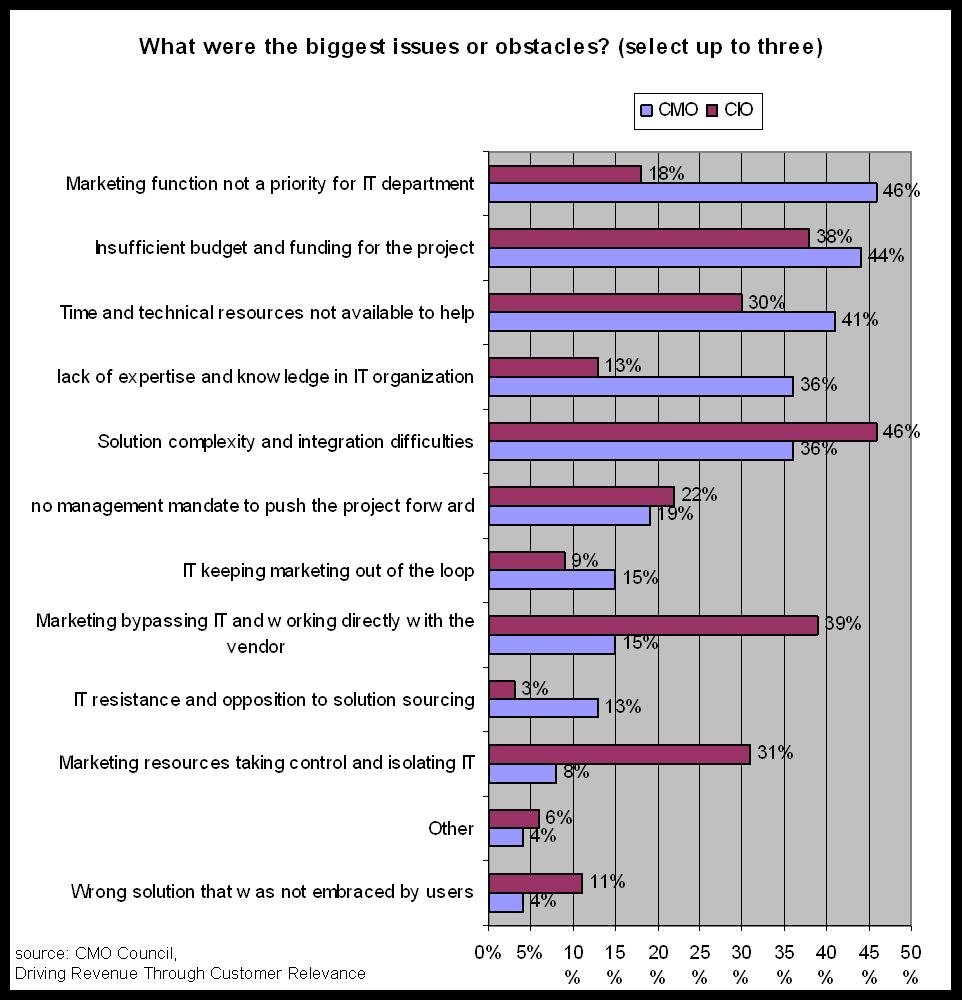
The CMO Council generously shared the detailed data with me. This provided hours of amusement as I recrunched the numbers from my own perspective. I’ve included some of results below with their permission (although of course the interpretations are my own). If you care about these issues, it’s well worth $199 to see the rest.

CMOs and CIOs agree they need to work together, and why. Both cited customer insight and analytics as top reasons to work together. Marketing measurement and ROI rank lower, although CMOs care about them more than CIOs seem to think.


They also agree they have much work to do:

- only 3% of CMOs and 1% of CIOs said their company was heavily committed and invested in interactive digital marketing strategies”

- just 8% of CMOs and 6% of CIOs said they had fully integrated online and offline analytics

But the relationship is far from perfect.

CMOs and CIOs often blame each other for failures.

- Many more CMOs than CIOs said they had “problems or challenges implementing marketing solutions or IT projects to further marketing effectiveness” (64% of CMOs vs. 48% of CIOs). That is, marketers are less happy that IT realizes.

- CMOs blamed failure on lack of IT priority, lack of IT expertise, IT keeping marketing “out of the loop” and IT resistance to solution sourcing.

- CIOs blamed failure on marketing bypassing IT and working directly with the vendor and marketing taking control and isolating IT.

- Both groups did agree on other causes including insufficient funding, lack of time and technical resources, solution complexity and lack of management support.


CMOs and CIOs select tools separately.

- CIOs were much more likely to base selections on consultation with technical groups (enterprise IT, web, contact center and back office) and somewhat more dependent on vendor interactions at conferences.

- CMOs rely more on consultations within marketing, including internal meetings, strategic planning and audits and assessments. But the CIO figures are still fairly high: CIOs are not ignoring marketing’s input, although marketing may be largely ignoring IT.

- Incidentally, both groups cited online research much more often than industry analysts, peer groups or formal needs assessments and RFPs. This reinforces the common notion that online information is increasingly more important for marketing system buyers.


CIOs are less in tune with digital marketing efforts than they think – and CMOs know it:

- 76% of CIOs felt their CIO understood marketing objectives and requirements, but just 54% of CMOs felt their CIO understood marketing needs.

- CMOs were nearly twice as likely as CIOs to feel their company is growing its digital marketing spend (35% of CMOs vs 20% of CIOs).

- CMOs were also more likely to think their firm was aggressively adopting new marketing technologies or was testing new solutions (combined 39% of CMOs vs. 28% of CIOs). CIOs were more likely to think the company was still at the evaluation stage or not a priority (combined 24% of CMOs vs. 34% of CIOs).

- CIOs were much more likely than CMOs to feel that IT was playing a major leadership role in digital marketing strategy. But the majority of both groups also listed the CMO as a digital marketing leader. Near-majorities also credited senior management.


CMOs and CIOs disagree on the CIO's job.

- CMOs take a limited view of the CIO's role. Mostly, they want the CIOto handle the mechanics of data and integration.


- CIOs agreed that better data was their first priority, but otherwise felt they should focus on new types of systems and interactions. They show particular interest in social media.


CMOs and CIOs have different views of spending, too.

- CMOs and CIOs agreed that they spend the most on operational activities including email, Web analytics and CRM. But...

- CMOs reported much more spending on campaign management, marketing platforms and marketing analytics than CIOs. Either the CIOs aren’t paying attention to marketing systems or the CMOs are spending money outside of IT. Or both.

- CMOs also reported more spending on email and search marketing than CIOs. That makes a bit more sense: much of that money doesn’t flow through IT.

- CIOs reported more infrastructure spending such as content management, data warehouse, customer interactions and call centers than CMOs. That one also makes more sense since many of those items fall outside of marketing.


Two more observations on spending:

- Reported spending on multi-channel campaign management and integrated marketing platforms (27% and 23% for CMOs, respectively) was much higher than spending on enterprise marketing management or marketing resource management (both at 10%). I personally think they are close to the same thing, so I’m guessing this is mostly about labels. But perhaps enterprise marketing management is truly a broader and more advanced concept – suggesting there is indeed a large untapped market.

- Spending on marketing performance analytics (22% of CMOs) was more common than spending on ROI modeling and performance measurement (11%) . Could be another labeling issue – or maybe ROI is more specific, more demanding and less common. You decide.
Read More
Posted in cio priorities, cmo surveys, demand generation marketing automation, enterprise marketing management | No comments

Tuesday, 3 August 2010

Marketo's Enterprise Edition and Revenue Cycle Management: Looking Under the Hood

Posted on 13:27 by Unknown
Summary: Marketo continues to follow its own path. Enterprise Edition adds the complex security needed by large organizations but sticks to simple campaign flows. Revenue Cycle Management blazes an important new trail for others to follow.

I finally caught up with Marketo for a briefing on their Enterprise Edition (announced in March) and Revenue Cycle Analytics (announced in May). Since both are somewhat old news, and Marketo describes them in detail on its Web site, I’ll just make a few comments.

Executive Edition shows what Marketo believes is needed to service large marketing organizations. The most extensive enhancements provide finer-grained control over user rights. This is critical in large organizations, where regional and product groups may be responsible for different market segments and where users will have different functional specialties and approval authorities. Enterprise Edition supports these by adding user roles, “lead partitions” to control access to database segments and “workspaces” to make Marketo objects (contents, campaigns, lists, etc.) available to different user groups. User roles (but not lead partitions or workspaces) are now available in Marketo’s Professional Edition as well.

These changes are a big advance over earlier versions of Marketo, which distinguished only between users and administrators and let all users access pretty much everything. Enterprise Edition also adds a “sandbox” environment for training, testing and development – the sort of things that small companies might do on a live system, but large organizations cannot safely allow.

The other major big-company need that Enterprise addresses is more sophisticated integration with other corporate systems. Related features include LDAP integration with enterprise security systems and a Web services API to call Marketo functions and access its data.

Perhaps most interesting is that Marketo did NOT expand the complexity of its actual campaign flows. These remain fundamentally linear: that is, all leads follow the same flow from step 1 to step 2 to step 3, etc. Rules within each step can deliver different treatments to different segments, but everyone still moves to the same next step unless they leave the campaign altogether. Other enterprise-level marketing automation systems can create different branches within their campaigns, so different segments follow entirely separate paths. This makes it easier to design and visualize fundamentally different treatments for different types of leads, something that matters more in a large enterprise with many different lead types. I’ve always considered branching campaign flows to be one of the key requirements for an enterprise-level marketing automation system. It seems that Marketo disagrees.

(Actually, Marketo disagrees with much of the preceding paragraph. Everything in it is factually accurate, but I'm happy to clarify that (1) several campaigns can run simultaneously, sending leads through different flows and (2) steps within Marketo campaigns can remove leads or send them to other campaigns (3) Marketo can connect several campaigns to produce the same flows as single branching campaign in other systems.)

Revenue Cycle Analytics breaks some important new ground. As I commented in an earlier post on purchase funnel measurement, Marketo’s approach is not conceptually unique. The basic idea is to track leads through stages in a purchase funnel, which is similar to pipeline reporting in many sales automation systems. It just starts earlier in the process.

However, Marketo's implementation brings this reporting to a new level. Most specifically, Marketo has introduced a star-schema reporting database, which I’m pretty sure no other marketing automation system currently offers. (Market2Lead had something similar but is no longer sold.) This is important because the structure of an operational marketing database, which most B2B marketing automation systems also use for reporting, makes it hard or impossible to do the necessary time-based analysis.

Other components are similarly sophisticated. These include graphical models that track movement of leads through the stages, detailed analytics with specialized measures such as conversion rates and speeds, statistical projections based on current inventory and historical flow rates, and executive dashboards. The models capture more than a simple linear pipeline: they support skipping and backwards flows among stages, splits within flows for different lead types, complex stage definitions, and transitional stages where leads are processed and reassigned.

Marketo is also tackling the difficult issue of allocating revenue to multiple individuals and marketing touches. Its methods are not particularly advanced: credit can be spread evenly or based on marketing-assigned weights. But no one else has found a much better solution, particularly at the low volumes of most B2B marketing programs.

My only real complaint is that you can't actually buy it all today. Marketo is releasing Revenue Cycle Analytics in stages. The database itself was available for the May announcement and the modeling engine was released in July. Initial analytics are set for delivery this month (August), with the really cool projections and dashboards out during the first half of next year. This delay could prove costly, since funnel-based marketing measurement is a hot topic and other vendors could well build or partner to deploy something similar in the interim.

Pricing of Revenue Cycle Analytics starts at $1,500 per month and grows with database size. Incidentally, I don’t think they’ve published that figure anywhere before, so there’s a bit of news in this post after all. Huzzah.
Read More
Posted in demand generation, enterprise marketing management, lead management, marketing automation, marketing measurement, marketo, revenue attribution | No comments
Older Posts Home
Subscribe to: Posts (Atom)

Popular Posts

  • 4 Marketing Tech Trends To Watch in 2014
    I'm not a big fan of year-end summaries and forecasts, mostly because I produce summaries and forecasts all year round.  But I pulled to...
  • Gainsight Gives Customer Success Managers a Database of Their Own
    I had a conversation last week with a vendor whose pitch was all about providing execution systems with a shared database that contains a un...
  • OfficeAutoPilot: Simple, Powerful, Low Cost Demand Generation for Small Business
    My personal definition of demand generations systems (see Introduction to Demand Generation Systems from the Raab Guide site) explicitly st...
  • Demand Generation Usability Scores - Part 3
    Usability Items for Complex Marketing Programs (note: this is a slightly revised version of the original post, reflecting vendor feedback....
  • Infer Keeps It Simple: B2B Lead Scores and Nothing Else
    I’ve nearly finished gathering information from vendors for my new study on Customer Data Platform systems and have started to look for patt...
  • First Look at New Marketo Release
    I’m going to diverge just slightly from my current obsession with usability to talk about a conversation I had today with Marketo President...
  • thinkAnalytics Helps Marketers Optimize Customer Treatments
    Summary: thinkAnalytics provides a robust decision engine to help make optimal recommendations across channels. Too bad more people don...
  • Treehouse Interactive MarketingView Combines Demand Generation with Campaign ROI Tracking
    I originally spoke with Treehouse Interactive in late January, but didn’t write about them because weren’t quite ready to talk about their ...
  • Demand Generation Implementation -- Take My Survey, Please!
    Update - 4/23/09: I have some preliminary results, but would still like more responses. Click here to take survey . One result of interest: ...
  • Clarifying the Differences Between Database and Digital Marketing
    Summary: Database and digital marketing are both data-driven. But they differ in plenty of other ways that make it hard for specialists in...

Categories

  • [x+1]
  • 1010Data
  • 2009 trends
  • 2010 predictions
  • 2011 predictions
  • 2013 marketing automation revenues
  • 2014 predictions
  • account data in marketing systems
  • acquisitions
  • acquistions
  • act-on software
  • active conversion
  • activeconversion
  • acxiom
  • ad agencies
  • ad servers
  • adam needles
  • adobe
  • adometry
  • advertising effectiveness
  • advocate management
  • affiliate marketing
  • agilone
  • aida model
  • aimatch
  • algorithmic attribution
  • alterian
  • analysis systems
  • analytical database
  • analytical databases
  • analytical systems
  • analytics tools
  • app exchange
  • app marketplace
  • application design
  • aprimo
  • are
  • artificial intelligence
  • ascend2
  • asset management
  • assetlink
  • atg
  • attribution analysis
  • attribution models
  • automated decisions
  • automated dialog
  • automated modeling
  • autonomy
  • b2b demand generation
  • b2b demand generation systems
  • b2b email marketing benchmarks
  • b2b lead scoring
  • b2b marketing
  • b2b marketing automation
  • b2b marketing automation industry consolidation
  • b2b marketing automation industry growth rate
  • b2b marketing automation revenues
  • b2b marketing automation systems
  • b2b marketing automation vendor rankings
  • b2b marketing data
  • b2b marketing industry consolidation
  • b2b marketing strategy
  • b2b marketing system comparison
  • b2c marketing automation
  • b2c marketing automation vendors
  • balanced scorecard
  • balihoo
  • barriers to marketing success
  • barry devlin
  • beanstalk data
  • behavior detection
  • behavior identification
  • behavior targeting
  • behavioral data
  • behavioral targeting
  • big data
  • birst
  • bislr
  • blogging software
  • brand experience
  • brand marketing
  • business intelligence
  • business intelligence software
  • business intelligence systems
  • business marketing
  • businses case
  • callidus
  • campaign flow
  • campaign management
  • campaign management software
  • causata
  • cdi
  • cdp
  • channel management
  • channel marketing
  • channel partner management
  • chordiant
  • cio priorities
  • clickdimensions
  • clicksquared
  • clientxclient
  • cloud computing
  • cmo surveys
  • cms
  • collaboration software
  • column data store
  • column-oriented database
  • columnar database
  • community management
  • compare marketing automation vendors
  • compiled data
  • complex event processing
  • consumer marketing
  • contact center systems
  • content aggregation
  • content distribution
  • content grazing
  • content management
  • content marketing
  • content matrix
  • content recommendations
  • content selections
  • content syndication
  • context automation
  • conversen
  • coremetrics
  • crm
  • crm integration
  • CRM lead scores
  • crm software
  • crm systems
  • crmevolution
  • cross-channel marketing
  • crowd sourcing
  • custom content
  • custom media
  • customer database
  • customer analysis
  • customer data
  • customer data integration
  • customer data management
  • customer data platform
  • customer data platforms
  • customer data quality
  • customer data warehouse
  • customer database
  • customer experience
  • customer experience management
  • customer experience matrix
  • customer information
  • customer management
  • customer management software
  • customer management systems
  • customer metrics
  • customer relationship management
  • customer satisfaction
  • customer success
  • customer support
  • cxc matrix
  • dashboards
  • data analysis
  • data cleaning
  • data cleansing
  • data enhancement
  • data integration
  • data loading
  • data mining
  • data mining and terrorism
  • data quality
  • data transformation tools
  • data visualization
  • data warehouse
  • database management
  • database marketing
  • database marketing systems
  • database technology
  • dataflux
  • datallegro
  • datamentors
  • david raab
  • david raab webinar
  • david raab whitepaper
  • day software
  • decision engiens
  • decision engines
  • decision management
  • decision science
  • dell
  • demand generation
  • demand generation implementation
  • demand generation industry
  • demand generation industry growth rate
  • demand generation industry size
  • demand generation industry trends
  • demand generation marketbright
  • demand generation marketing automation
  • demand generation software
  • demand generation software revenues
  • demand generation systems
  • demand generation vendors
  • demandforce
  • digiday
  • digital marketing
  • digital marketing systems
  • digital messaging
  • distributed marketing
  • dmp
  • dreamforce
  • dreamforce 2012
  • dynamic content
  • ease of use
  • ebay
  • eglue
  • eloqua
  • eloqua10
  • elqoua ipo
  • email
  • email marketing
  • email service providers
  • engagement engine
  • enteprise marketing management
  • enterprise decision management
  • enterprise marketing management
  • enterprise software
  • entiera
  • epiphany
  • ETL
  • eTrigue
  • event detection
  • event stream processing
  • event-based marketing
  • exacttarget
  • facebook
  • feature checklists
  • flow charts
  • fractional attribution
  • freemium
  • future of marketing automation
  • g2crowd
  • gainsight
  • Genius.com
  • genoo
  • geotargeting
  • gleanster
  • governance
  • grosocial
  • gsi commerce
  • high performance analytics
  • hiring consultants
  • hosted software
  • hosted systems
  • hubspot
  • ibm
  • impact of internet on selling
  • importance of sales execution
  • in-memory database
  • in-site search
  • inbound marketing
  • industry consolidation
  • industry growth rate
  • industry size
  • industry trends
  • influitive
  • infor
  • information cards
  • infusioncon 2013
  • infusionsoft
  • innovation
  • integrated customer management
  • integrated marketing management
  • integrated marketing management systems
  • integrated marketing systems
  • integrated systems
  • intent measurement
  • interaction advisor
  • interaction management
  • interestbase
  • interwoven
  • intuit
  • IP address lookup
  • jbara
  • jesubi
  • king fish media
  • kwanzoo
  • kxen
  • kynetx
  • large company marketing automation
  • last click attribution
  • lead capture
  • lead generation
  • lead management
  • lead management software
  • lead management systems
  • lead managment
  • lead ranking
  • lead scoring
  • lead scoring models
  • leadforce1
  • leadformix
  • leading marketing automation systems
  • leadlander
  • leadlife
  • leadmd
  • leftbrain dga
  • lifecycle analysis
  • lifecycle reporting
  • lifetime value
  • lifetime value model
  • local marketing automation
  • loopfuse
  • low cost marketing software
  • low-cost marketing software
  • loyalty systems
  • lyzasoft
  • makesbridge
  • manticore technology
  • mapreduce
  • market consolidation
  • market software
  • market2lead
  • marketbight
  • marketbright
  • marketgenius
  • marketing analysis
  • marketing analytics
  • marketing and sales integration
  • marketing automation
  • marketing automation adoption
  • marketing automation benefits
  • marketing automation consolidation
  • marketing automation cost
  • marketing automation deployment
  • marketing automation features
  • marketing automation industry
  • marketing automation industry growth rate
  • marketing automation industry trends
  • marketing automation market share
  • marketing automation market size
  • marketing automation maturity model
  • marketing automation net promoter score. marketing automation effectiveness
  • marketing automation pricing
  • marketing automation software
  • marketing automation software evaluation
  • marketing automation success factors
  • marketing automation system deployment
  • marketing automation system evaluation
  • marketing automation system features
  • marketing automation system selection
  • marketing automation system usage
  • marketing automation systems
  • marketing automation trends
  • marketing automation user satisfaction
  • marketing automation vendor financials
  • marketing automation vendor selection
  • marketing automation vendor strategies
  • marketing automion
  • marketing best practices
  • marketing cloud
  • marketing content
  • marketing data
  • marketing data management
  • marketing database
  • marketing database management
  • marketing education
  • marketing execution
  • marketing funnel
  • marketing integration
  • marketing lead stages
  • marketing management
  • marketing measurement
  • marketing mix models
  • marketing operating system
  • marketing operations
  • marketing optimization
  • marketing performance
  • marketing performance measurement
  • marketing platforms
  • marketing priorities
  • marketing process
  • marketing process optimization
  • marketing resource management
  • marketing return on investment
  • marketing ROI
  • marketing sales alignment
  • marketing service providers
  • marketing services
  • marketing services providers
  • marketing skills gap
  • marketing software
  • marketing software evaluation
  • marketing software industry trends
  • marketing software product reviews
  • marketing software selection
  • marketing software trends
  • marketing softwware
  • marketing suites
  • marketing system architecture
  • marketing system evaluation
  • marketing system ROI
  • marketing system selection
  • marketing systems
  • marketing technology
  • marketing tests
  • marketing tips
  • marketing to sales alignment
  • marketing training
  • marketing trends
  • marketing-sales integration
  • marketingpilot
  • marketo
  • marketo funding
  • marketo ipo
  • master data management
  • matching
  • maturity model
  • meaning based marketing
  • media mix models
  • message customization
  • metrics
  • micro-business marketing software
  • microsoft
  • microsoft dynamics crm
  • mid-tier marketing systems
  • mindmatrix
  • mintigo
  • mma
  • mobile marketing
  • mpm toolkit
  • multi-channel marketing
  • multi-language marketing
  • multivariate testing
  • natural language processing
  • neolane
  • net promoter score
  • network link analysis
  • next best action
  • nice systems
  • nimble crm
  • number of clients
  • nurture programs
  • officeautopilot
  • omnichannel marketing
  • omniture
  • on-demand
  • on-demand business intelligence
  • on-demand software
  • on-premise software
  • online advertising
  • online advertising optimization
  • online analytics
  • online marketing
  • open source bi
  • open source software
  • optimization
  • optimove
  • oracle
  • paraccel
  • pardot
  • pardot acquisition
  • partner relationship management
  • pay per click
  • pay per response
  • pedowitz group
  • pegasystems
  • performable
  • performance marketing
  • personalization
  • pitney bowes
  • portrait software
  • predictive analytics
  • predictive lead scoring
  • predictive modeling
  • privacy
  • prospect database
  • prospecting
  • qliktech
  • qlikview
  • qlikview price
  • raab guide
  • raab report
  • raab survey
  • Raab VEST
  • Raab VEST report
  • raab webinar
  • reachedge
  • reachforce
  • real time decision management
  • real time interaction management
  • real-time decisions
  • real-time interaction management
  • realtime decisions
  • recommendation engines
  • relationship analysis
  • reporting software
  • request for proposal
  • reseller marketing automation
  • response attribution
  • revenue attribution
  • revenue generation
  • revenue performance management
  • rfm scores
  • rightnow
  • rightwave
  • roi reporting
  • role of experts
  • rule-based systems
  • saas software
  • saffron technology
  • sales automation
  • sales best practices
  • sales enablement
  • sales force automation
  • sales funnel
  • sales lead management association
  • sales leads
  • sales process
  • sales prospecting
  • salesforce acquires exacttarget
  • salesforce.com
  • salesgenius
  • sap
  • sas
  • score cards
  • search engine optimization
  • search engines
  • self-optimizing systems
  • selligent
  • semantic analysis
  • semantic analytics
  • sentiment analysis
  • service oriented architecture
  • setlogik
  • setlogik acquisition
  • silverpop
  • silverpop engage
  • silverpop engage b2b
  • simulation
  • sisense prismcubed
  • sitecore
  • small business marketing
  • small business software
  • smarter commerce
  • smartfocus
  • soa
  • social campaign management
  • social crm
  • social marketing
  • social marketing automation
  • social marketing management
  • social media
  • social media marketing
  • social media measurement
  • social media monitoring
  • social media roi
  • social network data
  • software as a service
  • software costs
  • software deployment
  • software evaluation
  • software satisfaction
  • software selection
  • software usability
  • software usability measurement
  • Spredfast
  • stage-based measurement
  • state-based systems
  • surveillance technology
  • sweet suite
  • swyft
  • sybase iq
  • system deployment
  • system design
  • system implementation
  • system requirements
  • system selection
  • tableau software
  • technology infrastructure
  • techrigy
  • Tenbase
  • teradata
  • test design
  • text analysis
  • training
  • treehouse international
  • trigger marketing
  • twitter
  • unica
  • universal behaviors
  • unstructured data
  • usability assessment
  • user interface
  • vendor comparison
  • vendor evaluation
  • vendor evaluation comparison
  • vendor rankings
  • vendor selection
  • vendor services
  • venntive
  • vertica
  • visualiq
  • vocus
  • vtrenz
  • web analytics
  • web contact management
  • Web content management
  • web data analysis
  • web marketing
  • web personalization
  • Web site design
  • whatsnexx
  • woopra
  • youcalc
  • zoho
  • zoomix

Blog Archive

  • ▼  2013 (55)
    • ▼  December (4)
      • 4 Marketing Tech Trends To Watch in 2014
      • Webinar, December 18: How Marketers Can (Finally) ...
      • Woopra Grows from Web Analytics to Multi-Source Cu...
      • Optimove Helps Optimize Customer Retention (And, Y...
    • ►  November (5)
    • ►  October (4)
    • ►  September (3)
    • ►  August (5)
    • ►  July (5)
    • ►  June (5)
    • ►  May (6)
    • ►  April (6)
    • ►  March (1)
    • ►  February (6)
    • ►  January (5)
  • ►  2012 (56)
    • ►  December (4)
    • ►  November (3)
    • ►  October (6)
    • ►  September (4)
    • ►  August (7)
    • ►  July (3)
    • ►  June (4)
    • ►  May (5)
    • ►  April (3)
    • ►  March (4)
    • ►  February (8)
    • ►  January (5)
  • ►  2011 (74)
    • ►  December (9)
    • ►  November (8)
    • ►  October (6)
    • ►  September (5)
    • ►  August (5)
    • ►  July (3)
    • ►  June (6)
    • ►  May (5)
    • ►  April (6)
    • ►  March (8)
    • ►  February (7)
    • ►  January (6)
  • ►  2010 (75)
    • ►  December (9)
    • ►  November (9)
    • ►  October (5)
    • ►  September (6)
    • ►  August (7)
    • ►  July (3)
    • ►  June (6)
    • ►  May (9)
    • ►  April (4)
    • ►  March (6)
    • ►  February (6)
    • ►  January (5)
  • ►  2009 (96)
    • ►  December (2)
    • ►  November (4)
    • ►  October (5)
    • ►  September (9)
    • ►  August (7)
    • ►  July (16)
    • ►  June (9)
    • ►  May (5)
    • ►  April (11)
    • ►  March (11)
    • ►  February (11)
    • ►  January (6)
  • ►  2008 (59)
    • ►  December (6)
    • ►  November (3)
    • ►  October (8)
    • ►  September (1)
    • ►  August (5)
    • ►  July (8)
    • ►  June (5)
    • ►  May (5)
    • ►  April (6)
    • ►  March (3)
    • ►  February (3)
    • ►  January (6)
  • ►  2007 (84)
    • ►  December (4)
    • ►  November (6)
    • ►  October (6)
    • ►  September (1)
    • ►  August (4)
    • ►  July (7)
    • ►  June (16)
    • ►  May (20)
    • ►  April (20)
Powered by Blogger.

About Me

Unknown
View my complete profile