Marketing Deal Offers

  • Subscribe to our RSS feed.
  • Twitter
  • StumbleUpon
  • Reddit
  • Facebook
  • Digg
Showing posts with label marketing software trends. Show all posts

Friday, 22 November 2013

Marketing Automation News from Dreamforce: B2B More Integrated, B2C Stays Separate

Posted on 08:35 by Unknown
I spent the early part of this week at Salesforce.com’s annual Dreamforce conference. Here are my observations.

The big news was for geeks. The main theme of the conference was Salesforce1, a new set of technologies that make it vastly easier to deliver and integrate mobile versions of Salesforce-based applications. It is apparently a major technical accomplishment and at least one of my technical friends was hugely impressed. But I can’t say I personally found it all that exciting. Perhaps we’ve reached the point where we expect technology to do pretty much everything, so the line between what's already available and what's new is only visible to experts.  Any way you slice it, focusing on platform technology is much less exciting than last year's vision of "social enterprise".

The bad news was for B2B marketing automation. Conference presentations confirmed that Pardot, the B2B marketing automation system that Salesforce acquired as part of its ExactTarget acquisition, has been separated from the rest of ExactTarget and made part of the Sales cloud. There, Pardot is described only as providing lead scoring and nurture programs, which ignores landing pages, behavior tracking, and other features that B2B marketing automation usually provides (and Pardot includes). In terms of infrastructure, Pardot will eventually work directly from the CRM data objects, rather than maintaining its own synchronized database. (Data outside the CRM structure, such as detailed Web behaviors, will remain separate.)

What this means is that Salesforce sees B2B marketing automation as just an appendage of sales automation.  This is pretty much the same constricted view of marketing automation that Salesforce management has held all along.  The logical consequence is to make lead scoring and nurture campaigns standard features within the Sales offering and discard Pardot as a separate product.  I should stress that no one at Salesforce said this was their plan, but it seems inevitable. If and when that does happen, only the most demanding companies will purchase a separate B2B marketing automation product.

To put a more optimistic spin on the same news: Salesforce will continue to let independent B2B marketing automation apps synch with Sales.  If Salesforce does merge Pardot features into its core Sales product, then marketers who have a more expansive view of B2B marketing automation functions (or who simply want a system of their own) will be forced to buy from someone else.

The interesting news was that B2C marketing automation remains separate. Salesforce’s list of business groups includes the Sales Cloud, Service Cloud, and ExactTarget Marketing Cloud. Did you notice that just one of these has its own brand? As this suggests, and conference presentations confirm, Salesforce has kept B2C marketing distinct from its Sales and Service businesses, most importantly at the data and platform levels. The ExactTarget Marketing Cloud does now include Salesforce’s previously-purchased social marketing components, Radian6 social monitoring and Social.com social advertising. It also includes the iGoDigital predictive personalization technology that came along with the ExactTarget acquisition.

Salesforce did announce some plans to integrate the Marketing cloud with Sales and Service, but they are pretty much arm’s length: Marketing can receive alerts about changes in Sales (and I assume Service) data, even though that data remains separate; Sales and Service can send emails through the ExactTarget engine; Sales and Service can receive content recommendations from the Marketing predictive modeling tool. As near as I can tell, this is the same type of API-level integration available with any third-party system. For what it’s worth, the ExactTarget Marketing Cloud APIs are also part of Salesforce1, but don’t confuse that with sharing the same underlying platform.They don't.

The good news is the B2C marketing vision. It’s not really surprising that Salesforce kept its B2C platform separate, since Salesforce's core technology isn’t engineered for the massive data volumes and analytical processing needed for B2C in general and consumer Web marketing in particular. Happily, this technical necessity is accompanied by what strikes me as a sound vision for customer management.  ExactTarget framed this around three goals: single view of the customer; managing the customer journey; and personalized content across all channels and devices. It described major features for each of these: a unified metadata layer to access (and optionally import) data from all sources; a “customer journey” engine to manage multi-step, branching flows; and predictive modeling to select the best offers and contents across email and Web messages.

This felt like a more coherent approach than Salesforce described for the Sales cloud, where external data and predictive modeling in particular were barely mentioned (or, more precisely, are still being left to App Exchange partners). The ExactTarget cloud still lacks tools to associate customer identities across email, phone, postal, social, and other systems, although there are plenty of partners to provide them. I didn’t get a close look at the details of the ExactTarget functions, which will really determine how well it competes with other customer management platforms. But the general approach makes sense.

News of the revolution may be exaggerated. Salesforce argued during the AppExchange Partner keynote that the AppExchange and Salesforce platform have created a “golden age of enterprise apps” by enabling small software developers to sell to big enterprises. One part of the argument is that the platform itself lets small vendors break through the credibility and scalability barriers that have historically protected large enterprise software vendors. The other is that end-users can purchase and deploy apps without involving the traditional gatekeepers in enterprise IT departments. A corollary to this is that end-users have different priorities than IT buyers – in particular, end users care more about ease of use – so successful software will be different.

Of course, this is exactly what the AppExchange partners wanted to hear and exactly the strategy behind Salesforce’s platform approach in the first place. But that doesn’t necessarily make it untrue: and, if correct, it would indeed be a revolution in the enterprise software industry.

But some revolutions are bigger than others.  Even in an app-based world, individual users won't be making personal decisions about how to run core business processes.  Rather, systems will be chosen at the department level because companies can more or less safely assume that whatever the department chooses will integrate smoothly with the corporate backbone. That's certainly a change but bear in mind that departmental buyers will have the same preference as corporate IT groups for working with the smallest possible number of vendors. This means there will still be the familiar tendency for individual vendors to add more functions over time. So industry dynamics may change less than you’d expect.
Read More
Posted in app exchange, customer data management, dreamforce, exacttarget, marketing automation, marketing software trends, pardot, predictive modeling, salesforce.com | No comments

Tuesday, 12 February 2013

Why Is B2B Marketing Automation Growing So Slowly?

Posted on 13:23 by Unknown
Let me start by saying that the 50% revenue increase I’m projecting for B2B marketing automation in 2013 is a very healthy one. In actual dollars, the $250 million gain is much larger than the $175 million growth in 2012. So if you’re working in the industry, don’t circulate that resume just yet.


But still, as I noted last week, the growth rate is slowing – and for some vendors seems to have fallen considerably in the second half of 2012. The most notable is Eloqua, which as a public company has to report its results. Its year-on-year revenue was up 42% in first half of 2012 ($45 million vs. $31.7 million) but just 28% in the second half ($50.7 million vs. 39.6 million). That means even the absolute increase was down: $11.2 million vs. $13.3 million. Figures for other vendors are not publicly available but I've seen hints that several have slowed as well.

What really got me thinking about this was prepping for a Webinar I’ll be giving next Wednesday on the future of marketing automation (register here). I had figured to start off with my industry growth figures, but this led naturally to a question about long-term potential, which in turn leads to thoughts of market penetration rates.

We’ve recently been seeing surveys that suggest something close to 50% adoption of marketing automation.  For example, LoopFuse reported 42% of respondents had marketing automation in place, a Forrester study reported 45% use among B2B enterprise marketers, and the Lenskold Group found 70% marketing automation usage.*

If true, these figures would actually be bad news for marketing automation vendors.  They suggest the market is at least half way to saturation, after which growth would slow dramatically.

But most people in the industry are confident the potential is much larger than double the current market. The raw numbers suggest as much: according to data compiler Manta.com, there are nearly 1 million U.S. companies with $5 million or more revenue.** Of these, about 300,00 fall into B2B categories. Raab Associates' VEST report shows about 20,000 B2B marketing automation systems at those companies, yielding about 6% penetration. Not surprisingly, the rate is higher among larger firms.  I’ve excluded business under $5 million revenue from this analysis because that’s a very different market.


What accounts for the discrepancy between actual data and survey results? One answer is that people who answer surveys about marketing automation are disproportionately likely to be users.  So the untapped market is indeed much larger than surveys would suggest.

But here’s another, less comforting explanation. It’s a safe bet that at least half of current marketing automation users are in tech industries – call that 10,000 of the total. The Manta figures show 21,000 companies in the tech categories – computer hardware and software, ecommerce and IT outsourcing, electronics, and information technology. I know you can do this one in your head, but 10,000 clients among 21,000 companies means the tech sector is just under 50% penetrated.  This is pretty much what the surveys are telling us. And, yes, survey respondents do tend to be concentrated among tech companies.

Why is this worrisome?  Well, it suggests is that most B2B marketing automation growth is coming from mid-to-late adopters within the tech industry, not early adopters across a much larger universe.  That’s scary because everyone has expected a huge take-off when marketing automation finally transitions beyond the early stages of market development.  If the transition has already happened in tech and never gets started anywhere else, we'll never see that hyper growth.Quite the opposite: the tech pool will run dry in a year or two and growth will slow to a modest replacement rate.

A more tactical consideration is that  mid-to-late buyers have different purchasing styles (more risk averse, more support oriented, more price sensitive, more brand driven) than early adopters. There’s some evidence that B2B marketing automation vendors are moving their sales and marketing in this direction. This makes it even harder for them to sell to pioneers in other industries, who need the original missionary approach.

If you want another hint that the sky may be falling, how about this: a recent Econsultancy survey found that marketing automation is now lower priority among marketers than a year ago (top three for 11% vs. 15%). Since priority presumably translates to purchase intent, that seems to foreshadow a decline in new sales. I don’t want to make too much of this – the survey was among UK marketers and it also showed a sharp increase marketers who ranked marketing automation among their most exciting digital opportunities. Econsultancy’s explanation for the apparent contradiction was that most marketers already own a marketing automation system, so now they’re turning to exploiting it.  But while that's comforting on some levels, it still suggests lower future sales.


To be honest, I was less concerned about the year-to-year change in percentages than about marketing automation’s low rank in both years – next-to-last in 2012 and ninth of twelve in 2013. An IDC report from 2012 had similar results, ranking marketing automation seventh on a list of nine.


I have my own little theory about the low priority, which boils down to the fact that marketing automation only handles a fraction of marketers’ total activities.  Specifically, it supports email and online events, which a 2011 MarketingSherpa study found account for just 20% of program spending.  Even with direct mail and marketing automation itself, the total reaches only 37%. My theory is that marketing automation has a low priority because it is far from a complete customer management solution – or even a complete customer acquisition system.


There are other signs of early market maturity within my VEST data. One is greater concentration among the industry leaders.  My primary measure is employee counts, which are revealed by more vendors than revenue.  Last year, the top four industry vendors (Eloqua, Marketo, HubSpot, and Infusionsoft) added 49% more employees, compared with just 21% for the rest of the industry.  My revenue estimates show a similar gap although it's less pronounced. Revenue per employee is also about 20% higher for the top four vendors than all others combined; this is a sign of tight margins at smaller vendors, which make it hard for many to survive without outside funding. (That gap has actually shrunk since last year.)  Most tellingly, the past year hasn’t seen the rise of any fast-growing new challengers, in the way that Act-On and Pardot appeared in earlier years. This is yet another of industry stability and, perhaps, nascent consolidation.


So, is B2B marketing automation doomed to be no more than a niche application for tech marketers? Industry optimists would argue no, and point out that if half the clients are in tech, then the other half are not. Point taken. But it would be Panglossian to assume that other industries are simply waiting their turn to adopt marketing automation once the tech industry is saturated. In reality, I constantly discover new (to me) marketing automation products tailored to specific industries such as insurance, real estate, franchises, dentists, local retailers, and so on. I suspect the real reason the B2B marketing automation vendors haven’t had much success entering those territories is that they’re already occupied.

If that’s so, then the industry verticalization I’ve long expected has already happened and general purpose marketing automation vendors will have a much harder time than expected in selling to marketers outside of tech. As I suggested above, they’ll need a much more compelling story than one that leaves them at the bottom of priority lists even for tech marketers. Specifically, they’ll have to expand their scope to incorporate all marketing activities: a 20% solution just won’t be enough.
__________________________________________________________________

* Of course, the minute I posted this blog, I started to see additional figures.  A ClickZ article quoted 25% use by 38 B2B companies within the Fortune 500.  An Aberdeen study reported 30% adoption.  A BuyerZone survey returned 13% usage, although it probably included mostly small businesses. 

** Here's the Manta data if you want to play along at home.


Read More
Posted in b2b demand generation systems, b2b marketing automation industry growth rate, marketing software trends | No comments

Thursday, 27 September 2012

Three Ways to Dominate the Marketing Automation Industry

Posted on 18:31 by Unknown
I wrote last August that it’s still possible for new B2B marketing automation vendors to challenge the industry leaders. This was based on the observation that several of the smaller vendors have quickly reached the 1,000 client benchmark. But it didn’t answer the more interesting question of what it would take for a new vendor to really bypass the current leaders.

That particular question came up repeatedly during Dreamforce last week. The answer may not matter to marketers who don’t themselves work for a marketing automation vendor. But I think it’s worth pondering anyway, if only as an interesting case study in business strategy.

My own answer is: at stage of the industry, the basic features of marketing automation are pretty much set, so radically different features are not likely to emerge as a major competitive advantage. (That’s not to say new features won’t be important, particularly extensions into areas like social and mobile. But new features won’t be enough because they can be copied too quickly if they're really popular.) Rather, a new industry leader would have to remove the critical bottleneck to industry growth: the shortage of marketers with the skills needed to fully use marketing automation capabilities.

I don’t think I need to spend too much time defending that particular premise: if you want a data point, how about the widely quoted Sirius Decisions figure that 85% of marketers do not believe they are using their marketing automation platform to the fullest. Let's move onto the more important question: how could a vendor change the situation?

It seems to me there are three ways to approach this:

- make the systems radically easier to use. This is by far my preferred solution. It may seem an unobtainable goal: after all, ease of use has been a top priority of marketing automation vendors for years, and you’d think that by now all those smart people would have made things about as easy as they can be. But I think the right basis of comparison is Google AdWords, which made entry-level search engine marketing so incredibly simple that pretty much anyone can do it with no training at all.

As with AdWords, a radically simpler marketing automation system would just ask users to make a handful of basic decisions about content and target audience, and would build everything else automatically. Again like AdWords, the system would automatically optimize the programs based on results. This implies a degree of automation well beyond today’s marketing automation products, although increasingly common features like dynamic content and integrated predictive modeling offer a hint at how it could happen.

You could argue that marketers don’t want to delegate so much responsibility to a system, but many seem to have delegated to AdWords quite happily. Of course, AdWords also lets more sophisticated marketers make more decisions for themselves, and I’d expect any marketing automation system to provide that option as well. And, again as with search engine marketing, I’d expect the most sophisticated marketers to adopt more specialized systems than AdWords itself—but those will marketers will remain a minority.


- make it radically easier for marketers to use existing functions. This is not about making the functions themselves simpler: per my earlier comment, I’ll accept that all those smart folks have done about as much as possible in that direction. But I think more can be done to help marketers learn to use those functions more quickly and with less work.

What I have in mind specifically is “just in time” approaches that make it very easy for marketers to learn how to do a new task once they've started it, rather than taking separate training classes or looking up detailed instructions. This means context-sensitive help functions that can guess what you’re trying to do and offer advice when you seem to be having trouble. It also means lots of little instructional snippets instead of monolithic tutorials that have to be consumed all at once. This is standard stuff in the software industry, although some companies do it much better than others.

I think a marketing automation vendor who really focused on this would have a major advantage among new users, who are exactly the key audience.  If you want a specific benchmark for this approach, it’s that people can perform tasks with zero advance training.

- provide services so marketers don’t need to use the systems themselves. Quite a number of vendors have taken the services-based approach. In a way, it’s an admission of defeat: no, we really can’t make the systems simple enough for mere mortals. But I'd be happy to trade pride for success.

 The trick to this approach is to keep the service cost low enough that you can actually make money.  That comes down to things like prepackaged templates for creative materials and campaign flows, highly automated processes so the service staff can work efficiently, and standardized methodologies so inexperienced (ok, that's a euphemism for low cost) individuals can be easily trained to provide adequate service. Again, these are pretty standard things but I don’t think any vendor has really designed their system and business model around them.

Note that a system designed for efficient use by highly trained service people would look quite different from one designed for easy use and learning by lightly trained end-users. So this approach would really imply fundamental change in how vendors build their products.

As I said earlier, my preferred option is the first one, making systems radically simpler. But I’m guessing the more practical one is the middle choice of providing more effective help using systems similar to today’s. It’s possible that middle option isn’t viable: maybe vendors can’t provide enough additional help to make a difference. But I don’t think I’ve seen any vendor really focus on that option – and won’t concede I’m wrong until I have.
Read More
Posted in ease of use, marketing automation industry, marketing software trends, system design | No comments

Wednesday, 18 April 2012

Marketo Buys Crowd Factory, Silverpop Buys CoreMotives, and Other News from Pardot, Neolane, Act-On and OfficeAutoPilot

Posted on 19:10 by Unknown
With its usual fanfare, Marketo today announced the acquisition of social marketing campaign company Crowd Factory.

Crowd Factory is a certified cool product, which is probably reason enough for Marketo to buy them.  But what I find intriguing is how little the two businesses overlap.  Marketo is primarily focused on business marketing, and in particular lead generation, nurturing and analytics. Crowd Factory has some B2B clients but is clearly aimed at large-scale consumer marketing. Campaign types listed on its Web site include refer a friend, social sweepstakes, polls and voting, flash deals, group offers, and intelligent share buttons. Few would be considered relevant for most B2B campaigns.

Indeed, Marketo already had a reasonable set of B2B social marketing features. Here’s the chart I built last December in a post comparing social marketing features across the industry.


The yellow boxes represent capabilities added by Crowd Factory (although actual integration of the two products will probably take some time). As you see, Crowd Factory doesn’t fill many gaps. Rather, it adds B2C features that might will enable Marketo to penetrate a new set of accounts.


But it’s not fair to let Marketo get all the attention. Other vendors have also extended their products recently. These include:

Silverpop announced it had purchased CoreMotives, which adds marketing automation capabilities within Microsoft Dynamics CRM.  The company also announced plans to integrate Silverpop’s flagship Engage system with Dynamics CRM. The CoreMotives acquisition is quite interesting, since CoreMotives creates a merger of CRM and marketing automation (which I’ve long predicted) rather than the now-standard model of separate systems for each. The deal might be seen bet-hedging by Silverpop, although I suspect it’s more a way to penetrate accounts too small to buy a separate, sophisticated marketing automation or email product.

Pardot added features for search marketing.  These are keyword monitoring, which tracks the user’s site rank in Google and Bing, and competitor monitoring, which captures metrics such as Google PageRank, inbound links, and indexed pages. Data comes from several sources. This is an important enhancement and part of larger trend for marketing automation vendors to move beyond email and landing pages.

Neolane announced new features to identify anonymous Web visitors based on prior email interactions and to use external catalog data in dynamic offers.  Not as sexy as a social marketing acquisition but useful nevertheless. 

Act-On Software added dynamic content, progressive profiling, new survey components, search engine optimization meta-tags and source tracking, and performance reports. These are mostly catch-up features but the search engine optimization piece again shows the industry’s movement in that direction.

OfficeAutoPilot expanded its professional services offerings – another industry trend – and improved its tools for building forms and creating emails. They also announced the ability to purchase sky banners – you know, those things towed by airplanes – but that was just an April Fool’s joke. Pity.
Read More
Posted in marketing automation, marketing software trends, social campaign management | No comments

Sunday, 5 February 2012

Raab VEST Report: Marketing Automation Vendors Added Webinars, Social Media, and Dynamic Content in 2011

Posted on 14:22 by Unknown
Last week's post took a horse race approach to data from our newly available  B2B Marketing Automation Vendor Selection Tool (VEST): who’s ahead, who’s behind, and who is coming on strong. But that’s more important to industry insiders than the marketers who actually use these systems. Real marketers care about what the systems can do.

The VEST survey, covering nearly 200 items per vendor, answers that question in glorious detail. You need to examine the report itself to see answers for individual products. But aggregate data provides important context for understanding where the industry stands and where it’s headed.

Let’s start with the basics. I group vendors into three categories depending on their primary customers.

  • “micro” vendors sell largely to businesses under $5 million in revenue.  These include Infusionsoft, HubSpot, and OfficeAutoPilot.
  • “core” vendors sell to B2B companies with $5 to $500 million in revenue.  These include LeadFormix, Marketo, Genius,MakesBridge, Act-On Software, Right-On Interactive, SalesFUSION, Net-Results, LeadLife, Pardot, Silverpop, TreeHouse Interactive, Eloqua, Manticore Technology, and eTrigue.
  • “enterprise” vendors sell mostly to companies over $500 million revenue. These include Aprimo, Neolane, and Oracle.

As you might expect, products for larger companies have more features available.


(In this and following charts, “feature availability” is the ratio the actual vendor scores to the highest possible scores. The scores are on a scale of 0 to 2, where 0 means a feature is missing, 1 means it is partly available, and 2 means it is fully available. Having a “partly available” option introduces some dangerous wiggle room for aggressive self-scoring, but it doesn’t seem to have been used abused too badly: just 14% of the scores are 1, compared with 21% at 0, and 65% at 2.)


Remember, though: more features is not always better. A feature important to a large enterprise can make a system less suitable for a small company where the feature won’t be used but still adds cost and complexity. The VEST addresses this by providing different weighting schemes for the three types of customers. These weights reflect the most important features for each category and sometimes apply negative values to features that make a system less suitable for the target group. Scores calculated with those weights show that the core and enterprise vendors do about equally well at serving their target markets. The micro vendors have a little more room for improvement.


Speaking of improvement, we can also see how the industry has changed by comparing the new VEST with scores from one year ago.  This brings considerable good news: the micro and core vendors are indeed adding features, especially in lead generation, campaign management, and reporting. Enterprise systems are already so powerful that new features don’t matter much.

(The decline in “scoring and distribution” for the enterprise category is a bit of a fluke: one vendor was replaced by another with weaker scoring and distribution features. Because there are only three vendors in the group, this has a large impact on the total.).


The change in weighted scores shows roughly the same story – so, for the most part, vendors are adding features that matter.


But enough generalities. What really matters is specific features. Today I’ll look at the areas of greatest improvement. A later post will list key features that remain hard to find.

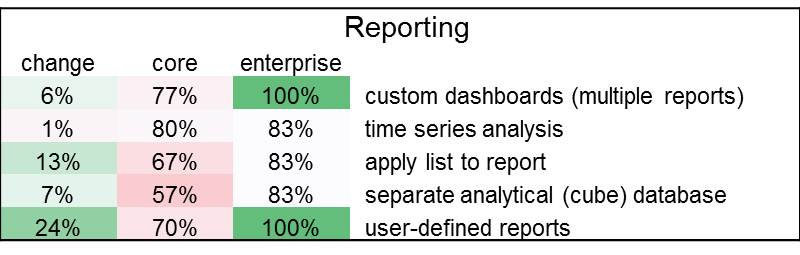
I’ll focus on the core vendors, since those are the systems that most B2B marketers will purchase. Each chart below has three columns:
  • “change”: the change in feature availability among core vendors, compared with the January 2011 VEST.
  • “core”: the feature availability for core vendors in the January 2012 VEST
  • “enterprise”: the feature availability for enterprise vendors in the January 2012 VEST.

Let’s start with three areas that gained a lot of industry attention last year: Webinars, social media, and revenue management.

Webinar Integration: Webinars are an increasingly important marketing tool, but traditionally systems like Webex had their own registration forms and result tracking. Moving the information into marketing automation required time-consuming file extractions and imports. Last year, the Webinar vendors began to expose APIs to allow automated integration with the marketing automation systems, and the marketing automation vendors leapt on the opportunity. As a result, availability of Webinar integration grew rapidly. This is a rare area where the core vendors outscore the enterprise vendors, perhaps because the enterprise vendors are less narrowly focused on B2B needs and/or because they tend to move more slowly at enhancing their products.


Social Media: It’s no news that social media is a hot topic among marketers, so it’s no surprise that vendors are adding features to support it. But even after last year’s improvements, anything beyond basic sharing and tracking remains hard to find. This is another area where the enterprise vendors are lagging. For a more nuanced analysis, see my blog post Social Media Features in Marketing Automation Systems: Who Does What? from last December.


Revenue Management: We heard plenty last year from marketing automation vendors about revenue management. The good news is that they’ve backed up their words with features. In fact, it’s surprising how widely many key revenue management requirements are available – many industry leaders can walk this walk, even though a few do most of the talking. Note also that the enterprise vendors do most of this as a matter of course.


Okay, those were interesting but expected.  What else were vendors working on last year? Several things, it turns out.


Reporting: Enterprise vendors have long had better reporting than the core marketing automation systems.  They still do but the gap is closing. A separate analytical database is especially important for advanced analytics in general and for revenue management reports in particular. Again, it’s more widely available than you might think.


Dynamic Content: This refers to embedding content selection rules within an email, Web form, or landing page. It’s not just personalization, which simply plucks information from a database field, and it’s not segmentation, which uses rules to select different content objects within the campaign flow. Dynamic content lets one email or Web form serve different segments, so marketers don’t have to create and keep track of so many separate versions. As you’d expect, it was traditionally used in enterprise systems where complexity is a more pressing challenge. Core marketing automation vendors didn’t talk about it much last year, but quite a few seem to have added it.


Cross-Campaign Coordination: This encompasses several features to help coordinate customer treatments across campaigns. As with dynamic content, these become important when companies are running complicated marketing programs and need to keep things under control. It’s another area where core marketing automation systems are closing the gap with enterprise vendors, although some distance still remains.


Lead Scoring: remember that old Sesame Street song, “One of these things is not like the others”? You wouldn’t expect lead scoring on a list of most-improved marketing automation features, since it’s been a key marketing automation capability all along. But last year did see substantial rise in systems that provide multiple scores per lead, and a smaller rise in the ability to recalculate leads on a schedule (as opposed to when a trigger event occurs). Both are markers of advanced systems.  We may see lead scoring on next year’s most-improved list too: plenty of vendors still lack other advanced lead scoring features. (If you’re wondering about the negative changes, they happened because several new vendors entered the core group with limited scoring features.)


So that's the good news: changes in areas the vendors talked about plus some changes they didn't necessarily trumpet.  Look for my next post to learn where they still need to strengthen their products.

Of course, the only thing more exciting than reading my analysis is to make your own.  For more information about the VEST report or to order your own copy, visit the RaabGuide Web site.

Read More
Posted in b2b marketing system comparison, demand generation vendors, marketing automation systems, marketing software trends | No comments
Older Posts Home
Subscribe to: Posts (Atom)

Popular Posts

  • 4 Marketing Tech Trends To Watch in 2014
    I'm not a big fan of year-end summaries and forecasts, mostly because I produce summaries and forecasts all year round.  But I pulled to...
  • Infer Keeps It Simple: B2B Lead Scores and Nothing Else
    I’ve nearly finished gathering information from vendors for my new study on Customer Data Platform systems and have started to look for patt...
  • Gainsight Gives Customer Success Managers a Database of Their Own
    I had a conversation last week with a vendor whose pitch was all about providing execution systems with a shared database that contains a un...
  • OfficeAutoPilot: Simple, Powerful, Low Cost Demand Generation for Small Business
    My personal definition of demand generations systems (see Introduction to Demand Generation Systems from the Raab Guide site) explicitly st...
  • First Look at New Marketo Release
    I’m going to diverge just slightly from my current obsession with usability to talk about a conversation I had today with Marketo President...
  • Demand Generation Usability Scores - Part 3
    Usability Items for Complex Marketing Programs (note: this is a slightly revised version of the original post, reflecting vendor feedback....
  • thinkAnalytics Helps Marketers Optimize Customer Treatments
    Summary: thinkAnalytics provides a robust decision engine to help make optimal recommendations across channels. Too bad more people don...
  • Salesforce.com and Oracle Buy Social Marketing Systems: Not the End of Marketing As We Know It
    Salesforce.com yesterday announced agreement to buy social media publishing vendor Buddy Media for $689 million, thereby adding another b...
  • NurtureHQ Offers "Dead Easy Marketing Automation". Is That Enough?
    I don’t know whether to laugh or cry. New-ish marketing automation vendor NurtureHQ showed me its product recently. It’s really nice. Cl...
  • Treehouse Interactive MarketingView Combines Demand Generation with Campaign ROI Tracking
    I originally spoke with Treehouse Interactive in late January, but didn’t write about them because weren’t quite ready to talk about their ...

Categories

  • [x+1]
  • 1010Data
  • 2009 trends
  • 2010 predictions
  • 2011 predictions
  • 2013 marketing automation revenues
  • 2014 predictions
  • account data in marketing systems
  • acquisitions
  • acquistions
  • act-on software
  • active conversion
  • activeconversion
  • acxiom
  • ad agencies
  • ad servers
  • adam needles
  • adobe
  • adometry
  • advertising effectiveness
  • advocate management
  • affiliate marketing
  • agilone
  • aida model
  • aimatch
  • algorithmic attribution
  • alterian
  • analysis systems
  • analytical database
  • analytical databases
  • analytical systems
  • analytics tools
  • app exchange
  • app marketplace
  • application design
  • aprimo
  • are
  • artificial intelligence
  • ascend2
  • asset management
  • assetlink
  • atg
  • attribution analysis
  • attribution models
  • automated decisions
  • automated dialog
  • automated modeling
  • autonomy
  • b2b demand generation
  • b2b demand generation systems
  • b2b email marketing benchmarks
  • b2b lead scoring
  • b2b marketing
  • b2b marketing automation
  • b2b marketing automation industry consolidation
  • b2b marketing automation industry growth rate
  • b2b marketing automation revenues
  • b2b marketing automation systems
  • b2b marketing automation vendor rankings
  • b2b marketing data
  • b2b marketing industry consolidation
  • b2b marketing strategy
  • b2b marketing system comparison
  • b2c marketing automation
  • b2c marketing automation vendors
  • balanced scorecard
  • balihoo
  • barriers to marketing success
  • barry devlin
  • beanstalk data
  • behavior detection
  • behavior identification
  • behavior targeting
  • behavioral data
  • behavioral targeting
  • big data
  • birst
  • bislr
  • blogging software
  • brand experience
  • brand marketing
  • business intelligence
  • business intelligence software
  • business intelligence systems
  • business marketing
  • businses case
  • callidus
  • campaign flow
  • campaign management
  • campaign management software
  • causata
  • cdi
  • cdp
  • channel management
  • channel marketing
  • channel partner management
  • chordiant
  • cio priorities
  • clickdimensions
  • clicksquared
  • clientxclient
  • cloud computing
  • cmo surveys
  • cms
  • collaboration software
  • column data store
  • column-oriented database
  • columnar database
  • community management
  • compare marketing automation vendors
  • compiled data
  • complex event processing
  • consumer marketing
  • contact center systems
  • content aggregation
  • content distribution
  • content grazing
  • content management
  • content marketing
  • content matrix
  • content recommendations
  • content selections
  • content syndication
  • context automation
  • conversen
  • coremetrics
  • crm
  • crm integration
  • CRM lead scores
  • crm software
  • crm systems
  • crmevolution
  • cross-channel marketing
  • crowd sourcing
  • custom content
  • custom media
  • customer database
  • customer analysis
  • customer data
  • customer data integration
  • customer data management
  • customer data platform
  • customer data platforms
  • customer data quality
  • customer data warehouse
  • customer database
  • customer experience
  • customer experience management
  • customer experience matrix
  • customer information
  • customer management
  • customer management software
  • customer management systems
  • customer metrics
  • customer relationship management
  • customer satisfaction
  • customer success
  • customer support
  • cxc matrix
  • dashboards
  • data analysis
  • data cleaning
  • data cleansing
  • data enhancement
  • data integration
  • data loading
  • data mining
  • data mining and terrorism
  • data quality
  • data transformation tools
  • data visualization
  • data warehouse
  • database management
  • database marketing
  • database marketing systems
  • database technology
  • dataflux
  • datallegro
  • datamentors
  • david raab
  • david raab webinar
  • david raab whitepaper
  • day software
  • decision engiens
  • decision engines
  • decision management
  • decision science
  • dell
  • demand generation
  • demand generation implementation
  • demand generation industry
  • demand generation industry growth rate
  • demand generation industry size
  • demand generation industry trends
  • demand generation marketbright
  • demand generation marketing automation
  • demand generation software
  • demand generation software revenues
  • demand generation systems
  • demand generation vendors
  • demandforce
  • digiday
  • digital marketing
  • digital marketing systems
  • digital messaging
  • distributed marketing
  • dmp
  • dreamforce
  • dreamforce 2012
  • dynamic content
  • ease of use
  • ebay
  • eglue
  • eloqua
  • eloqua10
  • elqoua ipo
  • email
  • email marketing
  • email service providers
  • engagement engine
  • enteprise marketing management
  • enterprise decision management
  • enterprise marketing management
  • enterprise software
  • entiera
  • epiphany
  • ETL
  • eTrigue
  • event detection
  • event stream processing
  • event-based marketing
  • exacttarget
  • facebook
  • feature checklists
  • flow charts
  • fractional attribution
  • freemium
  • future of marketing automation
  • g2crowd
  • gainsight
  • Genius.com
  • genoo
  • geotargeting
  • gleanster
  • governance
  • grosocial
  • gsi commerce
  • high performance analytics
  • hiring consultants
  • hosted software
  • hosted systems
  • hubspot
  • ibm
  • impact of internet on selling
  • importance of sales execution
  • in-memory database
  • in-site search
  • inbound marketing
  • industry consolidation
  • industry growth rate
  • industry size
  • industry trends
  • influitive
  • infor
  • information cards
  • infusioncon 2013
  • infusionsoft
  • innovation
  • integrated customer management
  • integrated marketing management
  • integrated marketing management systems
  • integrated marketing systems
  • integrated systems
  • intent measurement
  • interaction advisor
  • interaction management
  • interestbase
  • interwoven
  • intuit
  • IP address lookup
  • jbara
  • jesubi
  • king fish media
  • kwanzoo
  • kxen
  • kynetx
  • large company marketing automation
  • last click attribution
  • lead capture
  • lead generation
  • lead management
  • lead management software
  • lead management systems
  • lead managment
  • lead ranking
  • lead scoring
  • lead scoring models
  • leadforce1
  • leadformix
  • leading marketing automation systems
  • leadlander
  • leadlife
  • leadmd
  • leftbrain dga
  • lifecycle analysis
  • lifecycle reporting
  • lifetime value
  • lifetime value model
  • local marketing automation
  • loopfuse
  • low cost marketing software
  • low-cost marketing software
  • loyalty systems
  • lyzasoft
  • makesbridge
  • manticore technology
  • mapreduce
  • market consolidation
  • market software
  • market2lead
  • marketbight
  • marketbright
  • marketgenius
  • marketing analysis
  • marketing analytics
  • marketing and sales integration
  • marketing automation
  • marketing automation adoption
  • marketing automation benefits
  • marketing automation consolidation
  • marketing automation cost
  • marketing automation deployment
  • marketing automation features
  • marketing automation industry
  • marketing automation industry growth rate
  • marketing automation industry trends
  • marketing automation market share
  • marketing automation market size
  • marketing automation maturity model
  • marketing automation net promoter score. marketing automation effectiveness
  • marketing automation pricing
  • marketing automation software
  • marketing automation software evaluation
  • marketing automation success factors
  • marketing automation system deployment
  • marketing automation system evaluation
  • marketing automation system features
  • marketing automation system selection
  • marketing automation system usage
  • marketing automation systems
  • marketing automation trends
  • marketing automation user satisfaction
  • marketing automation vendor financials
  • marketing automation vendor selection
  • marketing automation vendor strategies
  • marketing automion
  • marketing best practices
  • marketing cloud
  • marketing content
  • marketing data
  • marketing data management
  • marketing database
  • marketing database management
  • marketing education
  • marketing execution
  • marketing funnel
  • marketing integration
  • marketing lead stages
  • marketing management
  • marketing measurement
  • marketing mix models
  • marketing operating system
  • marketing operations
  • marketing optimization
  • marketing performance
  • marketing performance measurement
  • marketing platforms
  • marketing priorities
  • marketing process
  • marketing process optimization
  • marketing resource management
  • marketing return on investment
  • marketing ROI
  • marketing sales alignment
  • marketing service providers
  • marketing services
  • marketing services providers
  • marketing skills gap
  • marketing software
  • marketing software evaluation
  • marketing software industry trends
  • marketing software product reviews
  • marketing software selection
  • marketing software trends
  • marketing softwware
  • marketing suites
  • marketing system architecture
  • marketing system evaluation
  • marketing system ROI
  • marketing system selection
  • marketing systems
  • marketing technology
  • marketing tests
  • marketing tips
  • marketing to sales alignment
  • marketing training
  • marketing trends
  • marketing-sales integration
  • marketingpilot
  • marketo
  • marketo funding
  • marketo ipo
  • master data management
  • matching
  • maturity model
  • meaning based marketing
  • media mix models
  • message customization
  • metrics
  • micro-business marketing software
  • microsoft
  • microsoft dynamics crm
  • mid-tier marketing systems
  • mindmatrix
  • mintigo
  • mma
  • mobile marketing
  • mpm toolkit
  • multi-channel marketing
  • multi-language marketing
  • multivariate testing
  • natural language processing
  • neolane
  • net promoter score
  • network link analysis
  • next best action
  • nice systems
  • nimble crm
  • number of clients
  • nurture programs
  • officeautopilot
  • omnichannel marketing
  • omniture
  • on-demand
  • on-demand business intelligence
  • on-demand software
  • on-premise software
  • online advertising
  • online advertising optimization
  • online analytics
  • online marketing
  • open source bi
  • open source software
  • optimization
  • optimove
  • oracle
  • paraccel
  • pardot
  • pardot acquisition
  • partner relationship management
  • pay per click
  • pay per response
  • pedowitz group
  • pegasystems
  • performable
  • performance marketing
  • personalization
  • pitney bowes
  • portrait software
  • predictive analytics
  • predictive lead scoring
  • predictive modeling
  • privacy
  • prospect database
  • prospecting
  • qliktech
  • qlikview
  • qlikview price
  • raab guide
  • raab report
  • raab survey
  • Raab VEST
  • Raab VEST report
  • raab webinar
  • reachedge
  • reachforce
  • real time decision management
  • real time interaction management
  • real-time decisions
  • real-time interaction management
  • realtime decisions
  • recommendation engines
  • relationship analysis
  • reporting software
  • request for proposal
  • reseller marketing automation
  • response attribution
  • revenue attribution
  • revenue generation
  • revenue performance management
  • rfm scores
  • rightnow
  • rightwave
  • roi reporting
  • role of experts
  • rule-based systems
  • saas software
  • saffron technology
  • sales automation
  • sales best practices
  • sales enablement
  • sales force automation
  • sales funnel
  • sales lead management association
  • sales leads
  • sales process
  • sales prospecting
  • salesforce acquires exacttarget
  • salesforce.com
  • salesgenius
  • sap
  • sas
  • score cards
  • search engine optimization
  • search engines
  • self-optimizing systems
  • selligent
  • semantic analysis
  • semantic analytics
  • sentiment analysis
  • service oriented architecture
  • setlogik
  • setlogik acquisition
  • silverpop
  • silverpop engage
  • silverpop engage b2b
  • simulation
  • sisense prismcubed
  • sitecore
  • small business marketing
  • small business software
  • smarter commerce
  • smartfocus
  • soa
  • social campaign management
  • social crm
  • social marketing
  • social marketing automation
  • social marketing management
  • social media
  • social media marketing
  • social media measurement
  • social media monitoring
  • social media roi
  • social network data
  • software as a service
  • software costs
  • software deployment
  • software evaluation
  • software satisfaction
  • software selection
  • software usability
  • software usability measurement
  • Spredfast
  • stage-based measurement
  • state-based systems
  • surveillance technology
  • sweet suite
  • swyft
  • sybase iq
  • system deployment
  • system design
  • system implementation
  • system requirements
  • system selection
  • tableau software
  • technology infrastructure
  • techrigy
  • Tenbase
  • teradata
  • test design
  • text analysis
  • training
  • treehouse international
  • trigger marketing
  • twitter
  • unica
  • universal behaviors
  • unstructured data
  • usability assessment
  • user interface
  • vendor comparison
  • vendor evaluation
  • vendor evaluation comparison
  • vendor rankings
  • vendor selection
  • vendor services
  • venntive
  • vertica
  • visualiq
  • vocus
  • vtrenz
  • web analytics
  • web contact management
  • Web content management
  • web data analysis
  • web marketing
  • web personalization
  • Web site design
  • whatsnexx
  • woopra
  • youcalc
  • zoho
  • zoomix

Blog Archive

  • ▼  2013 (55)
    • ▼  December (4)
      • 4 Marketing Tech Trends To Watch in 2014
      • Webinar, December 18: How Marketers Can (Finally) ...
      • Woopra Grows from Web Analytics to Multi-Source Cu...
      • Optimove Helps Optimize Customer Retention (And, Y...
    • ►  November (5)
    • ►  October (4)
    • ►  September (3)
    • ►  August (5)
    • ►  July (5)
    • ►  June (5)
    • ►  May (6)
    • ►  April (6)
    • ►  March (1)
    • ►  February (6)
    • ►  January (5)
  • ►  2012 (56)
    • ►  December (4)
    • ►  November (3)
    • ►  October (6)
    • ►  September (4)
    • ►  August (7)
    • ►  July (3)
    • ►  June (4)
    • ►  May (5)
    • ►  April (3)
    • ►  March (4)
    • ►  February (8)
    • ►  January (5)
  • ►  2011 (74)
    • ►  December (9)
    • ►  November (8)
    • ►  October (6)
    • ►  September (5)
    • ►  August (5)
    • ►  July (3)
    • ►  June (6)
    • ►  May (5)
    • ►  April (6)
    • ►  March (8)
    • ►  February (7)
    • ►  January (6)
  • ►  2010 (75)
    • ►  December (9)
    • ►  November (9)
    • ►  October (5)
    • ►  September (6)
    • ►  August (7)
    • ►  July (3)
    • ►  June (6)
    • ►  May (9)
    • ►  April (4)
    • ►  March (6)
    • ►  February (6)
    • ►  January (5)
  • ►  2009 (96)
    • ►  December (2)
    • ►  November (4)
    • ►  October (5)
    • ►  September (9)
    • ►  August (7)
    • ►  July (16)
    • ►  June (9)
    • ►  May (5)
    • ►  April (11)
    • ►  March (11)
    • ►  February (11)
    • ►  January (6)
  • ►  2008 (59)
    • ►  December (6)
    • ►  November (3)
    • ►  October (8)
    • ►  September (1)
    • ►  August (5)
    • ►  July (8)
    • ►  June (5)
    • ►  May (5)
    • ►  April (6)
    • ►  March (3)
    • ►  February (3)
    • ►  January (6)
  • ►  2007 (84)
    • ►  December (4)
    • ►  November (6)
    • ►  October (6)
    • ►  September (1)
    • ►  August (4)
    • ►  July (7)
    • ►  June (16)
    • ►  May (20)
    • ►  April (20)
Powered by Blogger.

About Me

Unknown
View my complete profile