Marketing Deal Offers

  • Subscribe to our RSS feed.
  • Twitter
  • StumbleUpon
  • Reddit
  • Facebook
  • Digg
Showing posts with label marketing automation systems. Show all posts

Tuesday, 15 October 2013

Marketing Automation's Unhappy Users: Trouble in Paradise?

Posted on 06:40 by Unknown
As I mentioned in last week's post, I’m writing a paper on stages of marketing automation deployment. Key findings will be presented in a Webinar next Thursday, sponsored by TreeHouse Interactive; you can register here. The paper itself will be available to Webinar attendees.

The premise of the paper and Webinar is marketing automation has a problem: clients who don’t move beyond basic email functions are unhappy. Last week’s post provided statistics that show how many marketers fail to make this transition, but it didn’t actually show why this matters. So let’s look at some more data that illustrates the trouble in marketing automation paradise.

First we’ll start with the paradise itself: B2B marketing automation has indeed been growing quickly, at about 50% per year over the past few years according to my estimates.  I do expect that to slow somewhat in 2014 as the core market of tech companies approaches saturation and adoption in other industries remains spotty. The great hope is that acquisitions by Oracle, Salesforce.com, Adobe, and other big software vendors finally push the industry across this classic Geoffrey Moore chasm from the beachhead niche to mainstream users, but that’s by no means certain to happen.


If and when that growth does occur, it will be fueled by positive experiences of previous users. But the news on that front is mixed: a survey by one of the industry’s best analysts, Jim Lenskold, found 60% of marketing automation users reporting increases in the key value measures of lead quantity and quality. That’s a happy majority, but it also means that about 30% found no improvement or even a decline.


Questions about satisfaction give a similarly ambiguous result: just over two-thirds of users in a Winsper Group survey reported themselves satisfied with the business value of their system, again meaning that nearly one-third were neutral or actively dissatisfied.


Even more scary (and just in time for Halloween, if you're still looking for a costume): yet another survey, this by Holger Schulze, found that 31% of current marketing automation users anticipate changing their system within the next two years, nearly always because they want better or different capabilities.


Although these figures come from different sources, they all point to the same conclusion: about 30% of marketing automation users are not happy with their systems. The Schulze survey suggests that most believe a different system will give them better results, so they’re not yet ready to give up on marketing automation entirely.

But will those users really do any better with a different product? I’d be the last person to say that all marketing automation systems are the same, but it's also true that the vast majority of systems purchased have all the functions needed to run a successful marketing program. Some fraction of users really did buy the wrong product, but I’ve no doubt that most have problems due to flawed deployment.

One final survey reinforces this point. This one, from BtoB Online, found that just 26% of users had fully deployed their system – and nearly 40% had only some or moderate adoption.

I’d guess that the dissatisfied users in the earlier surveys are concentrated in the low deployment groups in this survey.  But if that’s true, those marketers are abandoning their systems before giving them a real chance. The BtoB survey does show that strong and complete adoption have increased considerably from 2012 to 2013, which is good news.  It also shows that full adoption will double next year, which would be even better news if it happened – but those figures probably reflect aspirations more than reality.


All of this brings us back to where we started: rather than blaming their tools, marketers need to work harder at ensuring full deployment of the systems they’re already purchased. Join me at next week’s Webinar for a roadmap to making this happen.
Read More
Posted in demand generation systems, marketing automation adoption, marketing automation benefits, marketing automation systems, marketing automation user satisfaction, marketing cloud, marketing software | No comments

Wednesday, 17 October 2012

Microsoft Buys Marketing Automation Vendor MarketingPilot: Start of Something Big?

Posted on 16:51 by Unknown

Microsoft today announced the acquisition of marketing management system vendor MarketingPilot, which will become part of its Dynamics CRM group. Financial terms were not disclosed.

MarketingPilot is best described as integrated marketing management for mid-tier companies. It has a pretty low profile in the B2B marketing automation world, partly because it serves a mix of B2C and B2B clients but mostly because it started as a marketing operations management system. It only recently added standard B2B marketing automation features including a customer-level marketing database, outbound email, landing pages, lead scoring, Web behavior tracking, reporting, and Salesforce.com integration. Still, with more than 500 clients, including many ad agencies, MarketingPilot is a significant player in the larger marketing software universe. (I profiled them in a February 2011 post.)

The acquisition is significant on several levels. Most obviously, it’s another example of an adjacent vendor finding the marketing automation attractive: following Pardot’s acquisition last week by email vendor ExactTarget, and earlier acquisitions of Leadformix by CallidusCloud (sales effectiveness), Alterian by SDL (Web content), SmartFocus by Emailvision (email), and Demandforce by Intuit (small business accounting). More specifically, it’s a major acquisition by a CRM vendor, helping to fulfill everyone's favorite prophecy that marketing automation and CRM will eventually merge. I still doubt Salesforce.com will get the message any time soon, but maybe they'll listen a little more closely.

But the real significance may be greater. It’s no coincidence that MarketingPilot, like three of the five other deals I just listed, involves a B2C rather than B2B marketing automation product. The B2C products are generally built on a more powerful foundation than B2B systems, in terms of having a more flexible database structure, deeper marketing operations support, and more powerful analytics. B2B systems strengths are concentrated in execution capabilities like email design, landing pages, multi-step campaigns, and social messaging.

The stronger foundations of the B2C systems make them easier to extend throughout the marketing department, which would benefit from tightly integrated collaboration, planning, analytics, and database management. There’s less value to sharing B2B strengths in execution, since each group builds and deploys programs independently. (In other words: acquisition and nurture campaigns are built by separate groups that create their own emails and landing pages, but do want common planning systems, customer data, and analytics.)

This foundation technology matters because it’s pretty clear that the future of marketing systems is to have a shared platform – think Salesforce.com AppExchange, or the similar marts created by Eloqua, Marketo, HubSpot, and indeed Microsoft Dynamics itself – supporting a variety of plug-and-play applications. B2B marketing automation systems are built for lead nurturing and provide a foundation adequate for that purpose. But marketing departments also need acquisition (or, if you prefer, inbound marketing) and customer support (or whatever comes after a lead is handed off to sales). A B2C platform can support those other functions. Even a good B2B platform might not.

I’m not saying that a B2C platform could extend all the way to running CRM. This might be possible but so far it seems that marketing and sales still need separate physical databases for adequate performance. But I can imagine a marketing platform that provides some services to a CRM system, such as predictive modeling, data enhancement, and reporting. Like users throughout marketing,  users in both sales and marketing would benefit from sharing them. So, at least for now, that is the degree of marketing automation / CRM consolidation I expect.

Fulfilling even this somewhat limited vision will take a lot of resources. B2B marketing automation vendors will need to rearchitect their systems on the more sophisticated platform. They’ll also need to significantly enhance their execution layer to take advantage of the platform’s greater power. I discussed some of this in last month’s post on ways to dominate the marketing automation industry: my preferred strategy, of radically easier execution, specifically depends on better analytics to make the systems automatically do more of the work in campaign design, execution, and optimization. That Microsoft of all companies will create a revolutionary advance in simplicity is a bit hard to imagine (snark alert!), but they do have the resources.  Even the potential for that result may encourage other deep-pocketed vendors to try the same thing. That could be the greatest significance of all.


Read More
Posted in b2b marketing automation industry consolidation, ease of use, marketing automation systems, marketingpilot, microsoft dynamics crm | No comments

Tuesday, 21 August 2012

Raab Report: OfficeAutoPilot, Infusionsoft and HubSpot Rate Highest in Marketing Automation for Very Small Business

Posted on 18:48 by Unknown

One of the most important features of our VEST report on B2B marketing automation systems is that it divides marketing automation users into distinct segments, each having a different set of needs. This matters because the systems all do roughly the same things, making it hard for inexperienced buyers to tell them apart. Many vendors – especially those who target the middle sector – also try to serve all types of companies, adding to the confusion. Where the vendors differ is in the details of how they implement the common features, applying approaches that are generally best suited to one type of marketing organization.

The VEST segmentation is based on company size, as measured by revenue. I'm painfully aware that this isn’t the ideal way to group users, since companies of the same size can still vary greatly in their needs and marketing sophistication. But revenue is objectively measureable and most marketing automation vendors can provide reasonably accurate client counts by revenue group. So we use it as a proxy for the other client differences.

The primary way we report on the different segments is by applying different weights to the same feature in our vendor scoring for each segment. This lets us rank vendors based on how their features and company strengths match against each sector’s needs. A key part of the approach is to penalize vendors with negative weights for features that are too advanced for a particular customer group. So far as I know, no other analysts do this in their scoring.  It avoids a common problem with scoring systems, that systems with the most features always win.


The chart above shows our ratings for the micro business sector, defined as companies with under $5 million in revenue. These are very small companies, typically run personally by an owner. They rarely have a full-time professional marketer on staff. Primary marketing interests are group emails, landing pages, and simple lead nurturing through email auto-responders. Before marketing automation, they typically use an email system (which also provides landing pages and simple nurture campaigns) or sales automation product for their marketing. They often do not integrate marketing automation with a separate sales automation system, either because they don’t use one at all or because they rely on CRM features within marketing automation itself. As of July 2012, marketing automation vendors reported more than 17,000 micro-business installations, just over 60% of the industry total. But, because prices are lower than other segments, the segment generates only an estimated 18% of industry revenue, or $65 million for full-year 2012.

Companies in this sector have very limited marketing and technical resources. As a result, their overriding needs are ease of use and a broad range of features within a single product. What they don’t need are very complex campaigns, extensive planning and budgeting, and custom database  designs. Our scoring reflects those priorities.

As the chart shows, the leaders in this segment are OfficeAutoPilot, Infusionsoft, and HubSpot. The first two are micro-business specialists; in particular, they have built-in CRM and order processing. HubSpot isn’t quite as highly tailored to this segment, which is why it is a little further from the top than the other two. (The vertical dimension is product fit, which basically means features.) But HubSpot has a very large number of clients in this segment, so it is still quite far to the right. (The horizontal dimension is vendor fit, a combination of customer count, segment concentration, and vendor resources.) Act-On and Marketo also have strong positions in this sector, even though their features – especially in Marketo’s case – are not necessarily the best fit. Again, bear in mind that revenue is a very crude segmentation, so many Act-On and Marketo clients in this group probably have requirements closer to those I’ve assigned to the middle tier.

The other important set of vendors are those at the upper left of the chart: companies with a strong feature fit even though they are smaller than the leaders. SalesFUSION and MakesBridge stand out especially in this group for micro-business users. Oracle’s presence is, frankly, pretty odd: it’s due to a low per seat price and the vendor’s position that it has a built-in CRM module. In fact, nine of the 22 vendors say they provide a CRM option, which may be technically correct but in most cases probably isn’t realistic. This is even more proof – as if it were needed – that buyers need to explore the products in detail before making a purchase.
Read More
Posted in marketing automation systems, micro-business marketing software, Raab VEST report, small business software | No comments

Tuesday, 7 February 2012

Raab VEST Report: Testing, Data Quality and Content Management Still Lag in Marketing Automation Products

Posted on 08:04 by Unknown

My last post looked at data from our just-released B2B Marketing Automation Vendor Selection Tool (VEST) to understand general industry trends and identify the greatest areas of improvement. Today we’ll look at the VEST data to see what’s still hard to find. As before, the charts show three columns: change in feature availability over the past year among core marketing automation vendors; current availability among core vendors; and current availability among enterprise vendors. See the previous post for details on the calculations.

Split Tests: Formal split testing of different content versions or customer treatments is the heart of marketing optimization, but many B2B marketers still don’t have the time or resources to do it. Given the lack of demand, it’s not too surprising that many vendors don’t offer strong testing features.  Still, I feel they have something approaching a moral obligation to provide these features and encourage their use.  Note that splits within lists, the one testing capability that is fairly common, is actually the hardest for marketers to use.  Testing features are much more available among enterprise systems, whose clients are more likely to conduct tests as a matter of course.


Value-Based Selection: This is arguably the next step after dynamic content (see my previous post), since it uses calculated values rather than user-crafted rules to select marketing contents or campaign actions. Like dynamic content, it reduces the complexity of marketing programs while allowing them to be more targeted. It's still much harder to find than dynamic content although it is becoming more available.  Again, enterprise vendors have a substantial lead over the core systems.


Integrate with Direct Mail Printer: This is admittedly a small tactical issue, but it's interesting in its own way.  There’s apparently a resurgence of interest of direct mail generally and post cards in particular as a way to avoid ever-more-cluttered email inboxes and social media channels. This is one of the few features that are more common among micro-business systems than the core group.


Project and Content Management: These features are most important for large marketing departments that need coordinate work of many people. Most core marketing automation systems can track the creation and last change date of an item. But serious administration requires much more detailed control over who makes changes, approvals, and project management. As marketing programs get more complicated at all sizes of companies, these features will become increasingly important.


Data Quality: These are features that give marketers more control over the data that goes into their systems. Like split testing, data quality is widely recognized as important but often ignored. Availability of these features actually went down last year because several new core vendors provided below-average support. Enterprise vendors, with their more sophisticated client base, support these features fully.


Data Management: These features each reflect a certain degree of data management sophistication, although there’s a reasonable case that a separate company table doesn’t matter much in practice. The opportunity table is critical for revenue analysis, and you see here that it’s widely available. Custom tables are needed to extend the marketing database beyond inputs from the CRM system. They used to be fairly rare but are now available in more than half of the core products.   But half full also means half empty, so buyers still need to check carefully to ensure a particular vendor supports their needs.


Reviewing this list of features, only value-based selection is really cutting edge.  The rest have long been standard for consumer marketing automation products and enterprise B2B.  They're missing from core B2B marketing automation systems because most of their clients are smaller, less sophisticated companies who haven't needed them.  This may never change for vendors focused on small marketing departments.  But vendors serving larger companies will add these features as their clients discover they need them.

For more information about the B2B Marketing Automation VEST report, please visit www.raabguide.com/vest.
Read More
Posted in compare marketing automation vendors, marketing automation systems, marketing software selection, Raab VEST, vendor evaluation | No comments

Sunday, 5 February 2012

Raab VEST Report: Marketing Automation Vendors Added Webinars, Social Media, and Dynamic Content in 2011

Posted on 14:22 by Unknown
Last week's post took a horse race approach to data from our newly available  B2B Marketing Automation Vendor Selection Tool (VEST): who’s ahead, who’s behind, and who is coming on strong. But that’s more important to industry insiders than the marketers who actually use these systems. Real marketers care about what the systems can do.

The VEST survey, covering nearly 200 items per vendor, answers that question in glorious detail. You need to examine the report itself to see answers for individual products. But aggregate data provides important context for understanding where the industry stands and where it’s headed.

Let’s start with the basics. I group vendors into three categories depending on their primary customers.

  • “micro” vendors sell largely to businesses under $5 million in revenue.  These include Infusionsoft, HubSpot, and OfficeAutoPilot.
  • “core” vendors sell to B2B companies with $5 to $500 million in revenue.  These include LeadFormix, Marketo, Genius,MakesBridge, Act-On Software, Right-On Interactive, SalesFUSION, Net-Results, LeadLife, Pardot, Silverpop, TreeHouse Interactive, Eloqua, Manticore Technology, and eTrigue.
  • “enterprise” vendors sell mostly to companies over $500 million revenue. These include Aprimo, Neolane, and Oracle.

As you might expect, products for larger companies have more features available.


(In this and following charts, “feature availability” is the ratio the actual vendor scores to the highest possible scores. The scores are on a scale of 0 to 2, where 0 means a feature is missing, 1 means it is partly available, and 2 means it is fully available. Having a “partly available” option introduces some dangerous wiggle room for aggressive self-scoring, but it doesn’t seem to have been used abused too badly: just 14% of the scores are 1, compared with 21% at 0, and 65% at 2.)


Remember, though: more features is not always better. A feature important to a large enterprise can make a system less suitable for a small company where the feature won’t be used but still adds cost and complexity. The VEST addresses this by providing different weighting schemes for the three types of customers. These weights reflect the most important features for each category and sometimes apply negative values to features that make a system less suitable for the target group. Scores calculated with those weights show that the core and enterprise vendors do about equally well at serving their target markets. The micro vendors have a little more room for improvement.


Speaking of improvement, we can also see how the industry has changed by comparing the new VEST with scores from one year ago.  This brings considerable good news: the micro and core vendors are indeed adding features, especially in lead generation, campaign management, and reporting. Enterprise systems are already so powerful that new features don’t matter much.

(The decline in “scoring and distribution” for the enterprise category is a bit of a fluke: one vendor was replaced by another with weaker scoring and distribution features. Because there are only three vendors in the group, this has a large impact on the total.).


The change in weighted scores shows roughly the same story – so, for the most part, vendors are adding features that matter.


But enough generalities. What really matters is specific features. Today I’ll look at the areas of greatest improvement. A later post will list key features that remain hard to find.

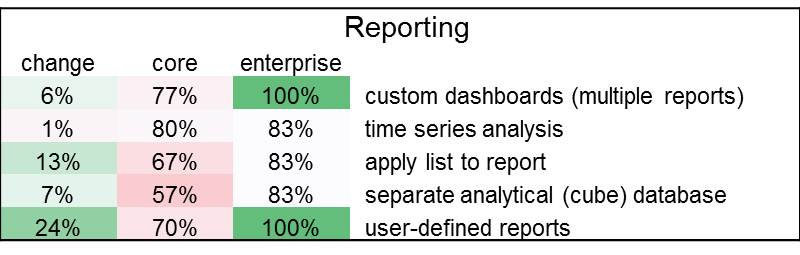
I’ll focus on the core vendors, since those are the systems that most B2B marketers will purchase. Each chart below has three columns:
  • “change”: the change in feature availability among core vendors, compared with the January 2011 VEST.
  • “core”: the feature availability for core vendors in the January 2012 VEST
  • “enterprise”: the feature availability for enterprise vendors in the January 2012 VEST.

Let’s start with three areas that gained a lot of industry attention last year: Webinars, social media, and revenue management.

Webinar Integration: Webinars are an increasingly important marketing tool, but traditionally systems like Webex had their own registration forms and result tracking. Moving the information into marketing automation required time-consuming file extractions and imports. Last year, the Webinar vendors began to expose APIs to allow automated integration with the marketing automation systems, and the marketing automation vendors leapt on the opportunity. As a result, availability of Webinar integration grew rapidly. This is a rare area where the core vendors outscore the enterprise vendors, perhaps because the enterprise vendors are less narrowly focused on B2B needs and/or because they tend to move more slowly at enhancing their products.


Social Media: It’s no news that social media is a hot topic among marketers, so it’s no surprise that vendors are adding features to support it. But even after last year’s improvements, anything beyond basic sharing and tracking remains hard to find. This is another area where the enterprise vendors are lagging. For a more nuanced analysis, see my blog post Social Media Features in Marketing Automation Systems: Who Does What? from last December.


Revenue Management: We heard plenty last year from marketing automation vendors about revenue management. The good news is that they’ve backed up their words with features. In fact, it’s surprising how widely many key revenue management requirements are available – many industry leaders can walk this walk, even though a few do most of the talking. Note also that the enterprise vendors do most of this as a matter of course.


Okay, those were interesting but expected.  What else were vendors working on last year? Several things, it turns out.


Reporting: Enterprise vendors have long had better reporting than the core marketing automation systems.  They still do but the gap is closing. A separate analytical database is especially important for advanced analytics in general and for revenue management reports in particular. Again, it’s more widely available than you might think.


Dynamic Content: This refers to embedding content selection rules within an email, Web form, or landing page. It’s not just personalization, which simply plucks information from a database field, and it’s not segmentation, which uses rules to select different content objects within the campaign flow. Dynamic content lets one email or Web form serve different segments, so marketers don’t have to create and keep track of so many separate versions. As you’d expect, it was traditionally used in enterprise systems where complexity is a more pressing challenge. Core marketing automation vendors didn’t talk about it much last year, but quite a few seem to have added it.


Cross-Campaign Coordination: This encompasses several features to help coordinate customer treatments across campaigns. As with dynamic content, these become important when companies are running complicated marketing programs and need to keep things under control. It’s another area where core marketing automation systems are closing the gap with enterprise vendors, although some distance still remains.


Lead Scoring: remember that old Sesame Street song, “One of these things is not like the others”? You wouldn’t expect lead scoring on a list of most-improved marketing automation features, since it’s been a key marketing automation capability all along. But last year did see substantial rise in systems that provide multiple scores per lead, and a smaller rise in the ability to recalculate leads on a schedule (as opposed to when a trigger event occurs). Both are markers of advanced systems.  We may see lead scoring on next year’s most-improved list too: plenty of vendors still lack other advanced lead scoring features. (If you’re wondering about the negative changes, they happened because several new vendors entered the core group with limited scoring features.)


So that's the good news: changes in areas the vendors talked about plus some changes they didn't necessarily trumpet.  Look for my next post to learn where they still need to strengthen their products.

Of course, the only thing more exciting than reading my analysis is to make your own.  For more information about the VEST report or to order your own copy, visit the RaabGuide Web site.

Read More
Posted in b2b marketing system comparison, demand generation vendors, marketing automation systems, marketing software trends | No comments

Thursday, 15 December 2011

Marketing Automation Interface Should Focus on Customers, Not Campaigns

Posted on 16:50 by Unknown

Several vendors have shown me their new campaign management interfaces recently. All were refined, attractive, and thoughtful. Each had subtle features that appeal to a connoisseur: floating tool pallets! Fly-over icon labels! Dynamic menus! Curved lines!  But they’re all still basically the same flow charts that Frank Gilbreth (of Cheaper by the Dozen fame) introduced in 1921 and we've seen in marketing systems for more than 20 years.


Now, I’m not saying marketing automation vendors should find a new approach just because I’m bored with the old one. But the truth is that the old way doesn’t work: every experienced developer I’ve ever spoken with has told me they’ve found users get confused when flow charts grow past a handful of branches. That’s true even though users themselves design campaigns by drawing a flow chart on a whiteboard. If you watch that process closely, you’ll see that (a) users themselves have trouble when their diagram gets too complex and (b) they can’t make much sense of it when they come back the next morning (assuming the whiteboard wasn’t erased).

Developers have taken two approaches to this challenge. One is to add features that help manage complexity – all those floating pallets and pop-up menus. These do help but it’s like Chaos Theory as explained in Jurassic Park: piling complexity on complexity eventually ends in a catastrophic collapse. The other approach is to simplify the experience by removing capabilities such as multiple branches and recursive loops. The extreme version of this is interfaces that define each campaign as a single sequence of steps, with no branching at all. This is certainly comprehensible but it can prevent marketers from doing what they want.

Something more radical is needed. Developers must think outside the flow chart. One way to start is to consider interfaces they’re already using in other systems.
  • touch screen. Dragging and poking at a flow chart with your fingers instead of a mouse wouldn’t be much of an improvement, although it would help. Creating splits by stretching an icon until it breaks into pieces might be kinda fun. Scaling up or down the way you zoom into online maps – and having the level of detail adjust automatically – would definitely be an improvement. But I’m guessing there are some more dramatic alternatives that avoid the flow chart altogether.  Think about your favorite touch screen apps and see what comes to mind. How could you design a marketing campaign with Angry Birds?
  • voice activation. I have no interest in speaking the same commands I could type. But a system that understands voice commands has natural language capabilities to infer what I need based on context and past experience, and thus save me the work of defining the details explicitly. (Think IBM Watson on Jeopardy or iPhone Siri.) If you think about the primal whiteboard scenario, what really happens is the marketers say “let’s add a split here” before drawing it – so a natural language approach could be a big time saver by skipping the drawing step altogether. Or the system might actually ask questions and make suggestions that lead the marketer through the design process: Who is your target market? How many reminder emails do you want? Might I suggest you add a reward: here are the best three to consider.
  • virtual reality. The biggest problem with flow charts is they are inherently two dimensional.  This means that intersecting branches must visually overlap, which is very confusing.  Could a virtual reality interface let marketers follow each path independently, like walking down a street or flying through a forest? This comes closer to simulating the customer’s experience – perhaps the marketer could be pelted with messages as she passes through (I’m thinking of monkeys throwing fruit), and toss them back as a response.  Or, imagine a road map that traces the customer's physical journey through  both the real world and cyberspace, with marketing messages presented as billboards and interactions as conversations with passersby.  Or could you map the customer journey itself – a trip through the funnel – with a similar presentation of billboards and conversations?  Think of a child's board game like Candyland or, perhaps more appropriate, Alice's trip down the rabbit hole. 
  • data visualization. Think of all those cool illustrations you’ve seen of social networks, molecular structures, Web behaviors, economic trends, geospatial data, manufacturing processes, and who knows what. Why can't marketing systems do better than flow charts and pie graphs? How about a three-dimensional campaign diagram that you can rotate and zoom on three axes? Or a six-dimensional view using height, width, depth, color, size, and shape, with a slider for time? Some of these might be hard to interpret but even a flow chart takes some training to understand. I'm certain that creative design can pack more information into a simpler package.
  • games and simulation. Could a marketing campaign sprout like a tree, growing more complex over time and bearing customers as fruit? Simulation games use simple rules and a few user choices to create elaborate cities, empires, and organisms. Some already let users run model businesses. More advanced versions of those programs could use rules derived from your customers' actual behavior to test alternative campaign designs and pick the ones most likely to succeed. The campaign details would be built by the system, so the interface becomes less important, although marketers would still need to review everything before deployment. These designs would be inserted into the matrix of existing programs, so the system could model each program’s incremental impact on the full customer lifecycle and on other program results. This leads directly to the Holy Grail of Marketing Optimization (which might make a fine multi-player quest game, come to think of it).
  • multiple views and viewpoints. Most of today's marketing automation systems already let administrators control which features are available to which users. But everyone with access to a given feature usually sees the same thing. The one exception is that salespeople are given wholly separate interfaces tailored to their needs. But this approach should be carried over to other personas within the marketing department – the CMO’s view of campaigns is radically different from the marketing operations person’s, and they should not be looking at the same flow chart. Even the same user might want different views at different times, depending on the task at hand.
  • customer perspective. I’ve already touched on this but it’s worth more attention. There’s a strong argument that the fundamental notion of separate marketing campaigns should be replaced by integrated customer treatments across all channels and life stages. The flow chart interface is based on the individual campaigns, and becomes impractically complex precisely when campaigns are expanded to accommodate too many contingencies. A customer-centered approach would develop rules for each situation rather than stringing together rules for many different situations. Those rules would be simpler because they dealt with a narrower range of conditions. They could also be spread between campaign logic and dynamic content logic, and many might be replaced altogether by predictive models that choose the highest-value treatment. The explosion of channels and contacts has made integrated customer treatments essential. Marketers need a fundamentally new interface designed to provide them.

Read More
Posted in campaign management software, ease of use, flow charts, marketing automation systems, user interface | No comments

Thursday, 8 December 2011

Social Media Features in Marketing Automation Systems: Who Does What?

Posted on 15:17 by Unknown
Social media is arguably overhyped as a marketing trend: it gets well under 10% of marketing budgets (different surveys have figures from 3% to 8%) and results are questionable (it was rated the least effective content marketing tactic in a recent MarketingProfs study).  But social is clearly growing fast and has great potential. So marketing automation vendors are understandably eager to support it in their systems.

I recently took a quick tour of vendor sites to see what social features they’re offering. Results are summarized in the table below. I need to stress that I’ve only credited vendors for features they list on their site. I strongly suspect that the data is incomplete, especially for basic features that are so common the vendors simply don’t bother to mention them. (Note: the table has been updated after the original post based on vendor feedback, so it's a bit more reliable than it was originally.)


The features fell into four broad categories:

• Basic posting and sharing: the most common features and the simplest level of social media marketing. As I wrote above, most vendors probably have most of them even though the chart doesn’t show them.

• Social media monitoring: watching social media for mentions of the company or other topics and responding when appropriate. Plenty of third party applications can do this, so providing it within the marketing automation system is mostly a matter of convenience.

• Importing social data: loading social data into the marketing automation database so it can be used for segmentation, analysis, and sharing with salespeople via CRM integration. This is harder than monitoring since it requires linking social identities to marketing leads and connecting to the social system’s API.

• Social platform integration: using native features of the social platforms by writing to their APIs. This can be tricky for the marketing automation vendors to build but it lets their clients take greater advantage of social media possibilities.


Looking at the chart as a whole, what stands out is the sheer variety: once you get past the basics, no features are common enough to consider them standard. This contrasts sharply with mature categories like email, landing pages, and nurture campaigns, where dozens of features are shared by most systems.  The reason is obvious – social media is still very young – but the disparity still provides interesting insights into what different vendors feel are most important to their clients.

The variety also illustrates that a great number of social media applications are possible (with plenty more to come). Naturally, the vendors will borrow features from each other, so we can expect some convergence over time..  A standard set of features will emerge as the industry figures out what’s really important.

The list below presents each vendor with a brief explanation of the table entries. Links on the vendor names go directly to the vendor Web page or press release that described their social media capabilities.  In cases where the data came from different sources, I've put the link on the items themselves.

Neolane
- posting: central panel to post tweets and Facebook updates
- sharing: place sharing buttons on emails
- tracking: measure clicks on links in system-generated posts.
- Facebook forms: use forms within Facebook pages and apps to gather customer permissions
- social sign-in: use social media sign-in services to replace marketing automation forms
- personalized Facebook ads: display different ad versions on a Facebook page based on the user’s profile, including both Facebook and non-Facebook data


Marketo
- sharing: place sharing buttons on landing pages
- tracking: measure visitors from the shared pages
- load Twitter feed: connector to load Twitter conversations to lead profiles and use the conversations in campaign rules


Eloqua
- sharing: place sharing buttons on emails and other marketing materials
- social sign-in: use social media sign-in services to replace marketing automation forms
- Klout segmentation: add Klout scores to lead profiles and use them in campaign rules
- show Twitter feed: let salespeople see a lead’s Twitter posts on their Profiler dashboard


IBM/Unica
- social monitoring: use CoreMetrics Social to find social media mentions of company


Aprimo
- posting: manage blog posts with review process and SEO recommendations
- sharing: place sharing buttons on email and microsites
- tracking: integrate with third party web analytics to track social referrals
- monitoring: integrate with third party social listening tools for monitoring


Pardot
- posting: central panel to schedule and send social messages
- load social profile: use Qwerly to import social media profiles and add to marketing automation lead profile
- show social profile: show social profile data in CRM


Silverpop
- posting: send posts to Twitter, Facebook, LinkedIn and/or RSS feeds along with email sends
- sharing: place sharing buttons on email
- social sign-in: use social media sign-in services to replace sign-in forms
- Facebook forms: add registration forms to Facebook and blogs
- badges and buttons: embed buttons and badges in email for Facebook, Twitter, Foursquare, StumbleUpon, XING


Act-On Software
- tracking: embed trackable links in system-generated posts
- social prospecting: find relevant social conversations and send to in-box; send template-based responses


SalesFusion
- sharing: place sharing buttons on email and landing pages
- tracking: embed trackable links in system-generated posts and online documents


TreeHouse Interactive
- sharing: place sharing buttons on email and landing pages
- tracking: embed trackable links in system-generated posts
- Facebook forms: build advanced forms that can work within Facebook pages


Net-Results
- load social profile: find data about visitors on Jigsaw, Linkedin, Twitter and post to marketing automation lead profile


Genius
- tracking: embed trackable links in personalized web promotions and chat messages


Loopfuse
- social monitoring: use Collecta realtime search to find social media mentions of company


HubSpot
- posting: send social media messages and blog posts
- sharing: place sharing buttons on blog posts and other content
- social monitoring: find social media mentions of company and respond
- Facebook forms: build ‘welcome’ app to capture leads on Facebook page


Read More
Posted in demand generation software, marketing automation systems, social media marketing, vendor comparison | No comments

Tuesday, 11 October 2011

Marketo Spark Targets Small Business Marketing Automation

Posted on 14:31 by Unknown
Marketo today announced the launch of Spark, a new brand aimed at small and mid-size business. Functionally, Spark is pretty much identical to the standard Marketo system. Exceptions are advanced features including revenue cycle reporting, email deliverability assistance, API access, fine-grained user rights management, and the Sales Insight salesperson application. Most of these aren’t of interest to small business, and several involve additional charges even for Marketo’s regular packages.

So the news here is price. Spark starts at $750 per month with no annual contract, compared with Marketo’s $2,000 per month minimum and annual contract for its full-featured Professional Edition. Marketo has discontinued its $1,200 per month Small Business Edition, which lacked some features now included with Spark.

In other words, this is a price cut. To me, it looks like a reaction to the success of other low cost small business systems, including HubSpot, Act-On Software, and Pardot. (HubSpot and Act-On have similar pricing to Spark, while Pardot runs a bit higher.)  Some of those firms are actually growing at a faster rate than Marketo, although on a smaller base.  Spark should help to blunt their momentum while increasing Marketo's own client total -- a closely watched metric, regardless of the associated revenue per client.

Whether Marketo actually makes any money at Spark's price is questionable. It really depends on the sales and support costs, and Marketo doesn’t appear to have changed how those are delivered to keep them down. Other small business specialists have designed sales and support models that are not as staff-intensive as traditional approaches. By contrast, Marketo is stressing that Spark includes services to help clients take advantage of their systems.

Of course, Marketo could have lowered its entry price without creating a new brand.  So why bother to launch Spark?

One reason may be to avoid cannibalizing sales of its other, higher-priced editions.  But, let’s face it, any sentient buyer will notice that Spark is out there. I think the more important reason is that Spark lets Marketo address small businesses separately from larger companies.  The two groups do have different needs and neither wants a system designed for the other.  Spark lets Marketo position itself as a small business specialist when selling to small businesses, without alienating big-business marketers who would consider a small business system an unsuitable toy. 


This is a delicate game.  For one thing, "small business" means different things to different people.  Small business specialists like Infusionsoft and OfficeAutoPilot actually serve a different market -- one that I label "microbusiness" and put at under $5 million revenue.  Those products have a different configuration from Spark, HubSpot, Pardot, or Act-On.  Specifically, Infusionsoft and OfficeAutoPilot have starting prices around $300 per month and offer built-in shopping carts and CRM.  (Other micro-business specialists like Genoo and MakesBridge also have a sub-$500 monthly price, but no CRM or shopping.)  Although Spark is not aimed at the micro-business market, some people may not recognize the distinction.


Nor it is clear that the Spark brand will be enough let Marketo play in both the small and mid-size business segments ($5 to $500 million revenue, by my definition) and the big business segment (more than $500 million revenue.)   Nearly every other marketing automation vendor focuses on one or the other.  The main exception is HubSpot, which is also trying to add larger clients without losing its small business base -- and facing some positioning challenges of its own.  

Spark also poses a financial challenge.  Marketo has said it will earn around $30 million revenue in 2011, and will have an average of around 1,100 clients.  That comes to about $2,500 per client per month, a figure Marketo has been striving to increase.  A large number of Spark clients at $750 per month would dramatically reduce its average.  The profit margins, if any, will surely be lower as well, again dragging down the corporate average.

Now, this is all interesting stuff, but does it matter to anyone who isn't a Marketo investor?  Probably not.  Spark may push prices a little lower and may put a small crimp in some competitors' growth rates.  It may also give small business marketers another fine set of resource materials to complement those from HubSpot and others.  But the bottom line is that similar capabilities were already available at a similar price point from Marketo and others. Spark just doesn't change much.

 
Read More
Posted in hubspot, infusionsoft, marketing automation systems, marketo, officeautopilot, pardot, small business software | No comments

Tuesday, 4 October 2011

More Systems for Business-to-Consumer Marketing Automation

Posted on 15:15 by Unknown
I spent yesterday prowling the exhibit hall at the Direct Marketing Association annual conference in Boston. This uncovered several additional candidates for mid-tier business-to-consumer marketing automation. I’ll list them here and also add them to my previous list of mid-tier marketing automation systems so that future visitors will find the complete set in one place.

This products below are a somewhat arbitrary selection, since pretty much every printer, service bureau, and email provider has a list selection tool. I’ve tried to include only products that can connect to a “real” marketing database, meaning it supports separate tables for customers, transactions, and contact history, and that allow multi-step campaign flows. 


RedPoint – a suite of tools for database building, campaign management, and analytics. Can be hosted by a service provider or run on-premise by the client. Highly scalable and mature – the company has been growing quietly for six years and has some very large clients.

BullsEye Marketing Systems – generates sophisticated outbound campaigns. The company’s major clients are cable TV systems but it also serves education and other areas. The system lacks an end-user interface for building campaigns; instead, these are built by the vendor based on client instructions.

Consolidated Technologies Group – a hosted system offering data hygiene, CRM, campaign management, digital asset management, and analytics. Sister company offers printing, direct mail and physical fulfillment. Cleveland-based with mostly local clients.

BFC – a hosted system tailored for central control over local marketers, such as franchisees. Provides multi-step, event-triggered campaigns, content creation, asset management, and multi-media output including Web-to-print.

Direxxis – also hosted, also designed for central control over local marketing.  Supports multi-channel campaigns, asset management, fulfillment, and performance measurement.

Of all these products, you'll note that only RedPoint is a general purpose marketing system.  BullsEye, BFC and Direxxis are specialized by vertical, and Consolidated Technologies is a regional player. Of course, if you happen to be in the market any of them serve, that’s an advantage.


Read More
Posted in campaign management software, enterprise marketing management, marketing automation systems | No comments

Tuesday, 2 November 2010

Oracle Buys ATG: Bad News for Marketing Automation?

Posted on 18:46 by Unknown
So…Oracle bought ATG today for $6.00 per share or, as the press release puts it with charming nonchalance, “approximately $1.0 billion”. I can’t exactly say I told you so, since this particular pairing never crossed my mind. But if you look back at my “doughnuts and pizza slices” post on software acquisitions, it does make perfect sense. ATG is a specialist in e-commerce (the ERM doughnut in the online operations pizza slice), an area where Oracle’s traditional ERM products are weak. As my model suggests it should, ATG also encompasses online CRM and online marketing, where Oracle’s Siebel line is also a little thin.

Since Oracle is already strong in offline ERM and offline analytics, ATG leaves Oracle just one slice short of a pie. In other words, Oracle needs a Web analytics product. With Omniture, CoreMetrics and Unica already gone, only Webtrends is an option…unless Oracle gobbles up Adobe. ‘nuff said.

So much for the obvious. What I really care about is the implications for marketing systems. I’d say the ATG purchase lessens the odds of Oracle buying a marketing automation vendor. The logic is this: buying ATG suggests that Oracle, like IBM (which put Unica in its WebSphere organization), is focusing on online marketing rather than marketing automation in general. Since ATG itself provides substantial online marketing functionality, there’s a smaller gap for Oracle to fill with a separate marketing automation purchase. Nor have I forgotten that Oracle already bought marketing automation vendor Market2Lead, plugging a different set of holes.

If anything, Oracle (and IBM) need to strengthen their position in online advertising. I'd look for them to buy tools to manage banner ads, search ads, and search engine optimization. This in turn could point towards investments in content management and digital asset management systems. That also leads further away from standard marketing automation.

The day-to-day impact of all this on marketers is slight. They still need marketing automation tools to do their jobs. If anything, they’re better served by having some marketing automation vendors remain independent, since this keeps prices down and encourages competitive innovation. A less-helpful result may be to further isolate digital marketing from other channels, when what we need is to integrate them more closely. Perhaps digital marketing systems will grow to the point that they take over offline marketing as well. I hadn't expected such a role reversal, but it’s certainly possible. Just ask Oedipus. Not that that turned out so well.
Read More
Posted in acquistions, atg, ibm, low cost marketing software, marketing automation systems, online marketing, oracle | No comments

Tuesday, 7 September 2010

True Influence's LeadPAC Offers Pay-Per-Click Email. Think About It.

Posted on 18:11 by Unknown
Summary: LeadPAC lets marketers pay for email responses as easily as they pay for search responses. It’s a major improvement over traditional lead generation.

I can’t recall a vendor with the same business model as LeadPAC from marketing automation vendor True Influence. That's pretty rare in itself, but what really matters is that LeadPAC's model offers some powerful benefits. That's worth some excitement.

So what, exactly, makes LeadPAC so special?

LeadPAC lets marketers order prospect lists based on segmentation criteria such as title, industry and company size. Nothing new there. The system will also send emails to those names without the marketer loading them into a separate system: a little harder to find but still far from unique. But here's the new part: users only pay for responses.

I’ve seen marketing agencies and direct response media that work on a cost-per-lead basis. But I’ve never seen it baked into the email engine of a marketing automation system. If you're aware of a similar product, please let me know.

Of course, the classic pay-per-click medium is paid search, and above all Google AdWords. It's no accident that LeadPAC resembles AdWords in both function and appearance. True Influence CEO Brian Giese said the goal with LeadPAC is to give marketers a way to create real leads quickly, using AdWords as a model.

Like AdWords, LeadPAC lets clients set a target cost per name and a weekly budget for their spending. Again like AdWords, the system keeps sending promotions – in this case, emails – until the budget is reached. The system further resembles AdWords in having some automated intelligence: in the case of LeadPAC, this means spacing the emails, limiting any name to one contact per week, and taking into account different response rates based on time of day and day of week. One thing it doesn't do – yet – is build predictive models to select the most responsive names within the specified universe. Nor is pricing based on AdWords-style bidding: clients pay a fixed fee ranging from $10 to $30 per name depending on the level (senior executives cost more than department managers). Just to be clear, that's all they pay: there's no fee for the marketing automation system itself.

Setting up a campaign in LeadPAC involves three basic steps.

- Select the audience by choosing from personal and company attributes including title, department, level, location, company size and ownership. The prospects come through LeadPAC’s partnerships with major consumer and business list vendors.

- Define the email to send, starting either with vendor-provided templates or by uploading a client's own template. LeadPAC provides a typical editor and standard features such as previewing the email and sending test messages.

- Define the campaign start date and weekly spending limit. Once clients submit their campaign, LeadPAC reviews it for content, reasonableness and compliance with anti-spam regulations.

Clients receive lists of responders on a regular basis. They can load these into any marketing automation system or True Influence's own marketing automation product, which lets them run multi-step nurture campaigns, apply lead scores, and synchronize data with Salesforce.com.

The beauty of all this, as with AdWords, is simplicity. Clients still need to specify their audience and create their email offer. But the cost-per-response model saves them the effort of managing details such as importing and refreshing lists, spacing their mailings over time, and tracking which segments respond best. This takes usability beyond the interface, by actually eliminating tasks rather than just making them easier to do. It makes email lead generation possible for companies that lack even basic skills in managing such programs.

Indeed, clients paying only for responses have little incentive to optimize their list selections or their copy. The vendor alone bears the cost of low response rates. This is probably part of the reason that True Influence reviews the campaigns for reasonableness.

Interestingly, one cure for this problem is to have clients do even less. If TrueInfluence deployed automated response modeling, it could avoid having anyone define target segments and still improve its response rates. Add some automated copy testing and marketers would be about as close to push-button lead generation as I can imagine.

Of course, email is just one part of lead generation and an even smaller part of full-scale marketing automation. So marketers will have plenty of work whether or not they use LeadPAC. But as an example of ways to really make marketing easier, LeadPAC is food for thought.
Read More
Posted in email marketing, lead generation, lead management, marketing automation systems, pay per click, pay per response | No comments

Thursday, 6 May 2010

Genoo Offers Web Marketing for Small Business

Posted on 07:38 by Unknown
Summary: Genoo provides a simple Web site, demand generation and social marketing for $199 per month. It’s not the most sophisticated system or the prettiest, but some small businesses may find it's just what they need.

Genoo offers a small-business-oriented Web marketing system at a small-business-friendly price of $199 per month. I’m somewhat grandly labeling it a “Web marketing system” rather than “demand generation” because its microsite could replace a small company’s primary Web site. Demand generation features are adequate, if a bit rudimentary, and are supplemented by social marketing capabilities that do an above-average job of integrating social activities with traditional lead data. Over all, it’s an option worth considering for businesses with limited funding and limited needs. (For other small business systems, see my list of demand generation vendors from last November.)

Let’s start with the microsites. Each Genoo subscription includes a single site with unlimited pages using the client’s own domain name. Pages can be built with Genoo’s free standard design templates or clients can pay Genoo $500 for a custom template. Each page can incorporate CSS style sheets, tags for search engine optimization, social sharing widgets, data capture forms, and visitor comments. Commenters are automatically entered as leads into the Genoo database. The commenting system captures a URL, link text and Twitter name in addition to the usual first/last name and email address.

All pages are built and managed through a content library, which can also contain materials such as images, downloadable files and link lists. An RSS manager lets visitors subscribe to selected items, simplifying programs such as newsletters. RSS subscribers can also be automatically added as leads.

Data capture forms can be displayed within a Genoo page or linked to an externally-hosted page through Genoo-provided Javascript. Either configuration will post data directly to the Genoo database. One major limitation is that the system supports only a fixed set of data fields (29 if I counted correctly). Genoo plans to let users add custom fields but hasn’t set a date for this feature. User-defined surveys, which allow some expansion in data storage, are due this fall.

The current system lets users build forms with any of the existing fields, change formatting, labels and sequence, and designate fields as mandatory. Once a form is submitted, Genoo can add a lead type and lead source to the submitter’s record. Submission can also trigger a confirmation email, send the visitor to a confirmation Web page, and send an alert email to company staff.

Each lead can be tagged with multiple lead types. These can be set by page comments, content downloads and list criteria in addition to form submissions. List criteria can be based on combinations of existing lead types, other lead attributes (location, industry, company size, budget, etc.) and behaviors such as number of site visits, time since last visit, and number of emails.

The system can send emails through list selections or nurture programs. Leads enter nurture programs through triggers, which can be based on assignment of a new lead type or Web events such as email clicks, page views and downloads. Nurture programs contain one or more emails, each sent a specified number of days after the initial trigger event. Genoo’s nurture capabilities are barebones by today’s demand generation standards – email is the only type of message available, there’s no way to send different emails to different leads within the same step, and there's no way to skip a step. Genoo does plan to add direct mail and telemarketing options.

Let me modify that last statement just a bit: most of Genoo’s nurture capabilities are barebones. The scheme to coordinate movement of leads across sequences is quite elaborate – in fact, the term “Byzantine” comes to mind. For each sequence, users can a specify a trigger that will remove leads from the sequence and can decide whether entry to the sequence will remove a lead from all other sequences or a list of specific sequences. So far so good.

But if users really want to get fancy, they can also assign each sequence to a numeric level within track. They can then specify, separately for each sequence, whether entry to the sequence will suspend a lead from all other sequences within a track, from all sequences at lower levels within the same track, or all sequences at lower levels in all tracks. They can also block leads from entering a new sequence if the lead is already active at a sequence on a higher level. This is a very powerful and flexible approach, although users must be well organized to apploy it effectively. Of course, users can ignore these features if they wish.

Lead scoring in Genoo is more straightforward. Points can be assigned for attributes and activities, including the usual Web behaviors (page visits, form submissions, downloads) and social behaviors (sharing, commenting, RSS subscription). This is a closer integration of social into lead scoring than I recall seeing elsewhere. Users also specify how far back to look when assigning points and set a score threshold to submit a lead to CRM. Genoo maintains only one score per lead – a big problem for companies that want to score leads against different products, but a limit that Genoo shares with many other demand generation products.

Genoo offers bidirectional synchronization with Salesforce.com, although only a handful of the company's 32 current clients actually use it. Users have considerable control over which leads are shared, with options to create queues for leads to send to Salesforce and to specify which Salesforce.com campaigns will send leads back to Genoo.

Users can also create shared and personal follow-up queues within Genoo, complete with notes and scheduled activities for individual leads. This lets Genoo to provide basic contact management for clients without a separate CRM system.

Reporting in Genoo is reasonably complete, including source tracking, referrals, search keywords, email campaign results, links clicks, forms filled out, and forward-to-friend forms. The system doesn’t use IP addresses to report on the companies of anonymous Web site visitors, although the vendor is exploring an alliance with a third party to add this feature. As I mentioned in an earlier post on social marketing, Genoo is among the handful of systems that track social click-throughs to the original sharer, allowing marketers to see which leads are actively driving traffic through social media.

These features are all included in Genoo’s base price of $199 per month, regardless of file size or Web activity. Users pay another $8.50 per thousand for emails sent, which won't add much to most clients' bills. Clients wishing to use Genoo as a sales automation system pay another $9.95 per sales user per month. Set-up and support are free and there’s a 30 day free trial.
Read More
Posted in demand generation, genoo, lead management, marketing automation systems, social media marketing | No comments

Tuesday, 2 February 2010

Can Database Marketers Learn Digital Tricks?

Posted on 18:46 by Unknown
Summary: Database marketing and digital marketing are more different than it seems. It's hard for experts in one to adjust to the other.

Yesterday’s post touched briefly on what I see as a fundamental transition between database marketing and digital marketing, and in particular on the changes that marketers and their supporting vendors must make to navigate the change successfully. This is an important topic, so I thought I’d return for a closer look.

It’s self-evident that digital marketing (mostly on the Internet, but also mobile, in-game, and eventually interactive TV) is a major change from both traditional mass media and more recent database marketing (mail, email, telemarketing, CRM). What’s less obvious is that the skills and attitudes that have served database marketers well for the past twenty or more years – an entire career for many – don’t transfer to the digital world. It’s true that database and digital marketing are both technology-enabled and thus seem as if they should draw on similar talents. But the similarities are superficial while the differences are profound.

Let’s cut to the core of the matter: the first rule of database marketing is that whoever has the biggest database, wins. Database marketers strive to gather ever-more information about their customers and (to a lesser extent, because less data is available) about their prospects. Their Holy Grail is the ever-receding “360 degree view of the customer,” a phrase I’ve always disliked because (a) it treats the customer as an object and (b) no one can possibly know everything about their customers. Today, at least to my mind, it also conjures up a full-body scan X-ray, an image I hope enough people find so offensive that it will finally put the phrase to rest.

Sorry for the rant. My point is that database marketers’ ideal is a perfectly detailed customer database, which would allow them to target precisely the “right offer to the right customer at the right time.” This attitude leads to highly structured, finely segmented campaigns and carefully-plotted, rules-driven interaction flows which make the best possible use of whatever data is actually available.

Digital marketers have no such illusions about the completeness of the data they could ever hope to assemble. I’m not saying many of them wouldn’t like to identify each person they interact with, just that this is obviously impossible in most situations. Thus, digital marketers start from a premise that they’ll be interacting with people cloaked by varying degrees of anonymity, and look for ways to make the best use of the limited information available. In one case this might a search term they used to reach a Web site; in another it might be a history of movies they and others have rented; in yet another it might be their current physical location. Most innovations in digital marketing involve improving the value extracted from such limited data, rather than attempting to link the data to an identity that can then be enhanced with large volumes of personal information from other sources.

(Caveat: yes, there are some major efforts aimed precisely at providing digital marketers with individual identities. But these run up against both the fundamental difficulty of identifying people in most digital media. Even more important, their value is limited because immediate past data about behavior and context is usually more powerful at predicting immediate future behavior than static personal information from external sources.)

A corollary to the limited and contextual nature of most digital customer data is that marketing programs don’t have enough information to make reliable predictions about the most appropriate treatments. Thus, multi-step marketing campaigns or highly structured interaction dialogs are less useful than simply giving people a variety of choices and letting them guide the process for themselves. Again, this is a matter of degree: deciding which choices to present itself requires predictions about which items the customers will prefer. But presenting multiple choices is quite different from trying to guess in advance which one is best.

In other words, we’re talking about a loss of control over the marketing process. This is still more obvious at the start of the marketing cycle, when companies are first attracting customers into a relationship. Database marketers spend lots of effort acquiring and enhancing prospect lists so they can decide whom to approach and which offers to send them. By contrast, most digital marketing contacts are initiated by the prospects themselves in response to an advertisement or social media message. Certainly digital marketers can select their advertising audiences, but this resembles traditional media buying more than an outbound direct marketing campaign. Even (or, perhaps, especially) with social media interactions, the marketer has very little control over what is communicated to whom.

Indeed, even though database marketers do plenty of acquisition, I think it’s fair to say that they find it relatively frustrating because the available data is generally so limited. Most would probably prefer to work on customer management – cross sell, upsell and retention – where richer data is available. By contrast, digital marketers have happily embraced the notion of “inbound marketing”, which is precisely the art of attracting new people to their products. To speculate still further, the reason that business marketers are adopting marketing automation much more enthusiastically than they ever adopted traditional database marketing may be that business marketing automation is largely being used in acquisition-friendly digital media, and business marketers are more acquisition-oriented (i.e., focused on lead generation) than their consumer marketing brethren.

Control is also a major differentiator when it comes to marketing measurement. Perhaps the proudest claim of database marketers is that all their efforts are highly and precisely measurable. Reality is a bit more messy, but it’s true that database marketing does support proper champion/challenger testing for companies willing to make the investment. Digital marketing also supports such testing. But many digital efforts involve display advertising where at least some of the value comes from exposures that do not prompt immediate, measurable activity. This is another area where digital marketing more closely resembles traditional mass media advertising than anything else. In fact, digital marketers increasingly base their measurements on consumer panels and surveys, almost precisely duplicating the conventional mass media approach. Again, the fundamental point is a difference in attitude: database marketers treat precise measurement as their ideal, even though they realize it isn’t fully attainable. Digital marketing doesn’t permit that illusion, so its practitioners can more easily accept less exact approaches.

By now I’ve probably annoyed many of my friends in both the database and digital marketing industries. Let me make clear that I’m not arguing that database marketing is obsolete or somehow inferior to digital marketing. They do different things and will coexist, just as mass media survived when database marketing appeared. In fact, good marketers will learn to integrate them effectively, letting each do what it does best. Actually, I’d argue that rule- and data-driven Website personalization has more in common with classic database marketing than with most digital marketing methods. In that case, integration between the two types of marketing happens within the Web site itself.

Nor am I arguing that database and digital marketing have nothing in common. Both are, obviously, dependent on technology and both are measurable in their own ways. Both work with customer databases – in fact, as digital marketers get better at capturing and integrating customer data, they will find themselves increasingly reliant on database marketing techniques. And, of course, both ultimately perform the basic marketing tasks of understanding their customers and using that knowledge effectively.

Rather, I’m trying to show that different skills and assumptions are needed for success in the two areas, and to suggest that this makes it difficult for people and organizations to transition from one to the other. This, in my opinion, is why the direct marketing agencies, marketing service providers and marketing software vendors who dominate the database marketing industry have not transferred their leadership to the digital marketing channels. The only new medium they easily adopted was email, but that was essentially database marketing to begin with.

This doesn’t mean that database marketing vendors are inevitably doomed or trapped in a shrinking specialty. But it does mean that those firms must recognize the fundamental differences between their old industry and the new one. They cannot make the easy but false assumption that digital marketing is a natural extension of database marketing techniques. Only the marketers and vendors who aggressively embrace digital marketing in its own terms will be able to lead the new industry.
Read More
Posted in database marketing, digital marketing, marketing automation systems, marketing services providers, online marketing | No comments
Older Posts Home
Subscribe to: Posts (Atom)

Popular Posts

  • 4 Marketing Tech Trends To Watch in 2014
    I'm not a big fan of year-end summaries and forecasts, mostly because I produce summaries and forecasts all year round.  But I pulled to...
  • Gainsight Gives Customer Success Managers a Database of Their Own
    I had a conversation last week with a vendor whose pitch was all about providing execution systems with a shared database that contains a un...
  • OfficeAutoPilot: Simple, Powerful, Low Cost Demand Generation for Small Business
    My personal definition of demand generations systems (see Introduction to Demand Generation Systems from the Raab Guide site) explicitly st...
  • Demand Generation Usability Scores - Part 3
    Usability Items for Complex Marketing Programs (note: this is a slightly revised version of the original post, reflecting vendor feedback....
  • Infer Keeps It Simple: B2B Lead Scores and Nothing Else
    I’ve nearly finished gathering information from vendors for my new study on Customer Data Platform systems and have started to look for patt...
  • First Look at New Marketo Release
    I’m going to diverge just slightly from my current obsession with usability to talk about a conversation I had today with Marketo President...
  • thinkAnalytics Helps Marketers Optimize Customer Treatments
    Summary: thinkAnalytics provides a robust decision engine to help make optimal recommendations across channels. Too bad more people don...
  • Treehouse Interactive MarketingView Combines Demand Generation with Campaign ROI Tracking
    I originally spoke with Treehouse Interactive in late January, but didn’t write about them because weren’t quite ready to talk about their ...
  • Demand Generation Implementation -- Take My Survey, Please!
    Update - 4/23/09: I have some preliminary results, but would still like more responses. Click here to take survey . One result of interest: ...
  • Clarifying the Differences Between Database and Digital Marketing
    Summary: Database and digital marketing are both data-driven. But they differ in plenty of other ways that make it hard for specialists in...

Categories

  • [x+1]
  • 1010Data
  • 2009 trends
  • 2010 predictions
  • 2011 predictions
  • 2013 marketing automation revenues
  • 2014 predictions
  • account data in marketing systems
  • acquisitions
  • acquistions
  • act-on software
  • active conversion
  • activeconversion
  • acxiom
  • ad agencies
  • ad servers
  • adam needles
  • adobe
  • adometry
  • advertising effectiveness
  • advocate management
  • affiliate marketing
  • agilone
  • aida model
  • aimatch
  • algorithmic attribution
  • alterian
  • analysis systems
  • analytical database
  • analytical databases
  • analytical systems
  • analytics tools
  • app exchange
  • app marketplace
  • application design
  • aprimo
  • are
  • artificial intelligence
  • ascend2
  • asset management
  • assetlink
  • atg
  • attribution analysis
  • attribution models
  • automated decisions
  • automated dialog
  • automated modeling
  • autonomy
  • b2b demand generation
  • b2b demand generation systems
  • b2b email marketing benchmarks
  • b2b lead scoring
  • b2b marketing
  • b2b marketing automation
  • b2b marketing automation industry consolidation
  • b2b marketing automation industry growth rate
  • b2b marketing automation revenues
  • b2b marketing automation systems
  • b2b marketing automation vendor rankings
  • b2b marketing data
  • b2b marketing industry consolidation
  • b2b marketing strategy
  • b2b marketing system comparison
  • b2c marketing automation
  • b2c marketing automation vendors
  • balanced scorecard
  • balihoo
  • barriers to marketing success
  • barry devlin
  • beanstalk data
  • behavior detection
  • behavior identification
  • behavior targeting
  • behavioral data
  • behavioral targeting
  • big data
  • birst
  • bislr
  • blogging software
  • brand experience
  • brand marketing
  • business intelligence
  • business intelligence software
  • business intelligence systems
  • business marketing
  • businses case
  • callidus
  • campaign flow
  • campaign management
  • campaign management software
  • causata
  • cdi
  • cdp
  • channel management
  • channel marketing
  • channel partner management
  • chordiant
  • cio priorities
  • clickdimensions
  • clicksquared
  • clientxclient
  • cloud computing
  • cmo surveys
  • cms
  • collaboration software
  • column data store
  • column-oriented database
  • columnar database
  • community management
  • compare marketing automation vendors
  • compiled data
  • complex event processing
  • consumer marketing
  • contact center systems
  • content aggregation
  • content distribution
  • content grazing
  • content management
  • content marketing
  • content matrix
  • content recommendations
  • content selections
  • content syndication
  • context automation
  • conversen
  • coremetrics
  • crm
  • crm integration
  • CRM lead scores
  • crm software
  • crm systems
  • crmevolution
  • cross-channel marketing
  • crowd sourcing
  • custom content
  • custom media
  • customer database
  • customer analysis
  • customer data
  • customer data integration
  • customer data management
  • customer data platform
  • customer data platforms
  • customer data quality
  • customer data warehouse
  • customer database
  • customer experience
  • customer experience management
  • customer experience matrix
  • customer information
  • customer management
  • customer management software
  • customer management systems
  • customer metrics
  • customer relationship management
  • customer satisfaction
  • customer success
  • customer support
  • cxc matrix
  • dashboards
  • data analysis
  • data cleaning
  • data cleansing
  • data enhancement
  • data integration
  • data loading
  • data mining
  • data mining and terrorism
  • data quality
  • data transformation tools
  • data visualization
  • data warehouse
  • database management
  • database marketing
  • database marketing systems
  • database technology
  • dataflux
  • datallegro
  • datamentors
  • david raab
  • david raab webinar
  • david raab whitepaper
  • day software
  • decision engiens
  • decision engines
  • decision management
  • decision science
  • dell
  • demand generation
  • demand generation implementation
  • demand generation industry
  • demand generation industry growth rate
  • demand generation industry size
  • demand generation industry trends
  • demand generation marketbright
  • demand generation marketing automation
  • demand generation software
  • demand generation software revenues
  • demand generation systems
  • demand generation vendors
  • demandforce
  • digiday
  • digital marketing
  • digital marketing systems
  • digital messaging
  • distributed marketing
  • dmp
  • dreamforce
  • dreamforce 2012
  • dynamic content
  • ease of use
  • ebay
  • eglue
  • eloqua
  • eloqua10
  • elqoua ipo
  • email
  • email marketing
  • email service providers
  • engagement engine
  • enteprise marketing management
  • enterprise decision management
  • enterprise marketing management
  • enterprise software
  • entiera
  • epiphany
  • ETL
  • eTrigue
  • event detection
  • event stream processing
  • event-based marketing
  • exacttarget
  • facebook
  • feature checklists
  • flow charts
  • fractional attribution
  • freemium
  • future of marketing automation
  • g2crowd
  • gainsight
  • Genius.com
  • genoo
  • geotargeting
  • gleanster
  • governance
  • grosocial
  • gsi commerce
  • high performance analytics
  • hiring consultants
  • hosted software
  • hosted systems
  • hubspot
  • ibm
  • impact of internet on selling
  • importance of sales execution
  • in-memory database
  • in-site search
  • inbound marketing
  • industry consolidation
  • industry growth rate
  • industry size
  • industry trends
  • influitive
  • infor
  • information cards
  • infusioncon 2013
  • infusionsoft
  • innovation
  • integrated customer management
  • integrated marketing management
  • integrated marketing management systems
  • integrated marketing systems
  • integrated systems
  • intent measurement
  • interaction advisor
  • interaction management
  • interestbase
  • interwoven
  • intuit
  • IP address lookup
  • jbara
  • jesubi
  • king fish media
  • kwanzoo
  • kxen
  • kynetx
  • large company marketing automation
  • last click attribution
  • lead capture
  • lead generation
  • lead management
  • lead management software
  • lead management systems
  • lead managment
  • lead ranking
  • lead scoring
  • lead scoring models
  • leadforce1
  • leadformix
  • leading marketing automation systems
  • leadlander
  • leadlife
  • leadmd
  • leftbrain dga
  • lifecycle analysis
  • lifecycle reporting
  • lifetime value
  • lifetime value model
  • local marketing automation
  • loopfuse
  • low cost marketing software
  • low-cost marketing software
  • loyalty systems
  • lyzasoft
  • makesbridge
  • manticore technology
  • mapreduce
  • market consolidation
  • market software
  • market2lead
  • marketbight
  • marketbright
  • marketgenius
  • marketing analysis
  • marketing analytics
  • marketing and sales integration
  • marketing automation
  • marketing automation adoption
  • marketing automation benefits
  • marketing automation consolidation
  • marketing automation cost
  • marketing automation deployment
  • marketing automation features
  • marketing automation industry
  • marketing automation industry growth rate
  • marketing automation industry trends
  • marketing automation market share
  • marketing automation market size
  • marketing automation maturity model
  • marketing automation net promoter score. marketing automation effectiveness
  • marketing automation pricing
  • marketing automation software
  • marketing automation software evaluation
  • marketing automation success factors
  • marketing automation system deployment
  • marketing automation system evaluation
  • marketing automation system features
  • marketing automation system selection
  • marketing automation system usage
  • marketing automation systems
  • marketing automation trends
  • marketing automation user satisfaction
  • marketing automation vendor financials
  • marketing automation vendor selection
  • marketing automation vendor strategies
  • marketing automion
  • marketing best practices
  • marketing cloud
  • marketing content
  • marketing data
  • marketing data management
  • marketing database
  • marketing database management
  • marketing education
  • marketing execution
  • marketing funnel
  • marketing integration
  • marketing lead stages
  • marketing management
  • marketing measurement
  • marketing mix models
  • marketing operating system
  • marketing operations
  • marketing optimization
  • marketing performance
  • marketing performance measurement
  • marketing platforms
  • marketing priorities
  • marketing process
  • marketing process optimization
  • marketing resource management
  • marketing return on investment
  • marketing ROI
  • marketing sales alignment
  • marketing service providers
  • marketing services
  • marketing services providers
  • marketing skills gap
  • marketing software
  • marketing software evaluation
  • marketing software industry trends
  • marketing software product reviews
  • marketing software selection
  • marketing software trends
  • marketing softwware
  • marketing suites
  • marketing system architecture
  • marketing system evaluation
  • marketing system ROI
  • marketing system selection
  • marketing systems
  • marketing technology
  • marketing tests
  • marketing tips
  • marketing to sales alignment
  • marketing training
  • marketing trends
  • marketing-sales integration
  • marketingpilot
  • marketo
  • marketo funding
  • marketo ipo
  • master data management
  • matching
  • maturity model
  • meaning based marketing
  • media mix models
  • message customization
  • metrics
  • micro-business marketing software
  • microsoft
  • microsoft dynamics crm
  • mid-tier marketing systems
  • mindmatrix
  • mintigo
  • mma
  • mobile marketing
  • mpm toolkit
  • multi-channel marketing
  • multi-language marketing
  • multivariate testing
  • natural language processing
  • neolane
  • net promoter score
  • network link analysis
  • next best action
  • nice systems
  • nimble crm
  • number of clients
  • nurture programs
  • officeautopilot
  • omnichannel marketing
  • omniture
  • on-demand
  • on-demand business intelligence
  • on-demand software
  • on-premise software
  • online advertising
  • online advertising optimization
  • online analytics
  • online marketing
  • open source bi
  • open source software
  • optimization
  • optimove
  • oracle
  • paraccel
  • pardot
  • pardot acquisition
  • partner relationship management
  • pay per click
  • pay per response
  • pedowitz group
  • pegasystems
  • performable
  • performance marketing
  • personalization
  • pitney bowes
  • portrait software
  • predictive analytics
  • predictive lead scoring
  • predictive modeling
  • privacy
  • prospect database
  • prospecting
  • qliktech
  • qlikview
  • qlikview price
  • raab guide
  • raab report
  • raab survey
  • Raab VEST
  • Raab VEST report
  • raab webinar
  • reachedge
  • reachforce
  • real time decision management
  • real time interaction management
  • real-time decisions
  • real-time interaction management
  • realtime decisions
  • recommendation engines
  • relationship analysis
  • reporting software
  • request for proposal
  • reseller marketing automation
  • response attribution
  • revenue attribution
  • revenue generation
  • revenue performance management
  • rfm scores
  • rightnow
  • rightwave
  • roi reporting
  • role of experts
  • rule-based systems
  • saas software
  • saffron technology
  • sales automation
  • sales best practices
  • sales enablement
  • sales force automation
  • sales funnel
  • sales lead management association
  • sales leads
  • sales process
  • sales prospecting
  • salesforce acquires exacttarget
  • salesforce.com
  • salesgenius
  • sap
  • sas
  • score cards
  • search engine optimization
  • search engines
  • self-optimizing systems
  • selligent
  • semantic analysis
  • semantic analytics
  • sentiment analysis
  • service oriented architecture
  • setlogik
  • setlogik acquisition
  • silverpop
  • silverpop engage
  • silverpop engage b2b
  • simulation
  • sisense prismcubed
  • sitecore
  • small business marketing
  • small business software
  • smarter commerce
  • smartfocus
  • soa
  • social campaign management
  • social crm
  • social marketing
  • social marketing automation
  • social marketing management
  • social media
  • social media marketing
  • social media measurement
  • social media monitoring
  • social media roi
  • social network data
  • software as a service
  • software costs
  • software deployment
  • software evaluation
  • software satisfaction
  • software selection
  • software usability
  • software usability measurement
  • Spredfast
  • stage-based measurement
  • state-based systems
  • surveillance technology
  • sweet suite
  • swyft
  • sybase iq
  • system deployment
  • system design
  • system implementation
  • system requirements
  • system selection
  • tableau software
  • technology infrastructure
  • techrigy
  • Tenbase
  • teradata
  • test design
  • text analysis
  • training
  • treehouse international
  • trigger marketing
  • twitter
  • unica
  • universal behaviors
  • unstructured data
  • usability assessment
  • user interface
  • vendor comparison
  • vendor evaluation
  • vendor evaluation comparison
  • vendor rankings
  • vendor selection
  • vendor services
  • venntive
  • vertica
  • visualiq
  • vocus
  • vtrenz
  • web analytics
  • web contact management
  • Web content management
  • web data analysis
  • web marketing
  • web personalization
  • Web site design
  • whatsnexx
  • woopra
  • youcalc
  • zoho
  • zoomix

Blog Archive

  • ▼  2013 (55)
    • ▼  December (4)
      • 4 Marketing Tech Trends To Watch in 2014
      • Webinar, December 18: How Marketers Can (Finally) ...
      • Woopra Grows from Web Analytics to Multi-Source Cu...
      • Optimove Helps Optimize Customer Retention (And, Y...
    • ►  November (5)
    • ►  October (4)
    • ►  September (3)
    • ►  August (5)
    • ►  July (5)
    • ►  June (5)
    • ►  May (6)
    • ►  April (6)
    • ►  March (1)
    • ►  February (6)
    • ►  January (5)
  • ►  2012 (56)
    • ►  December (4)
    • ►  November (3)
    • ►  October (6)
    • ►  September (4)
    • ►  August (7)
    • ►  July (3)
    • ►  June (4)
    • ►  May (5)
    • ►  April (3)
    • ►  March (4)
    • ►  February (8)
    • ►  January (5)
  • ►  2011 (74)
    • ►  December (9)
    • ►  November (8)
    • ►  October (6)
    • ►  September (5)
    • ►  August (5)
    • ►  July (3)
    • ►  June (6)
    • ►  May (5)
    • ►  April (6)
    • ►  March (8)
    • ►  February (7)
    • ►  January (6)
  • ►  2010 (75)
    • ►  December (9)
    • ►  November (9)
    • ►  October (5)
    • ►  September (6)
    • ►  August (7)
    • ►  July (3)
    • ►  June (6)
    • ►  May (9)
    • ►  April (4)
    • ►  March (6)
    • ►  February (6)
    • ►  January (5)
  • ►  2009 (96)
    • ►  December (2)
    • ►  November (4)
    • ►  October (5)
    • ►  September (9)
    • ►  August (7)
    • ►  July (16)
    • ►  June (9)
    • ►  May (5)
    • ►  April (11)
    • ►  March (11)
    • ►  February (11)
    • ►  January (6)
  • ►  2008 (59)
    • ►  December (6)
    • ►  November (3)
    • ►  October (8)
    • ►  September (1)
    • ►  August (5)
    • ►  July (8)
    • ►  June (5)
    • ►  May (5)
    • ►  April (6)
    • ►  March (3)
    • ►  February (3)
    • ►  January (6)
  • ►  2007 (84)
    • ►  December (4)
    • ►  November (6)
    • ►  October (6)
    • ►  September (1)
    • ►  August (4)
    • ►  July (7)
    • ►  June (16)
    • ►  May (20)
    • ►  April (20)
Powered by Blogger.

About Me

Unknown
View my complete profile