Marketing Deal Offers

  • Subscribe to our RSS feed.
  • Twitter
  • StumbleUpon
  • Reddit
  • Facebook
  • Digg

Wednesday, 21 April 2010

Are Experts Obsolete? Not In My Informed Opinion

Posted on 11:16 by Unknown
I recently tripped over an intriguing article on Extinction of the Expert by Denise Gershbein, a creative director at frog design. To be honest, I couldn’t quite follow her argument, but the gist seemed to be that true experts in the future will be people who can integrate information from multiple domains by leading teams of people who are themselves experts in different fields. I sense an infinite recursion here – are the “experts in different fields” themselves people who integrate other experts, or are they domain experts in the conventional sense? But as someone who makes a living based on my own claims of expertise, I’m less interested in Gershbein’s answer than her original question of whether experts will soon be obsolete.

My short answer, you won’t be surprised to learn, is no. Maybe I'm biased by self-interest, but it seems perfectly clear that there are many situations when the collective wisdom of the Internet won’t suffice. If I need a plumber or surgeon or marketing consultant, I need someone who can solve my individual problem, not provide generic advice or spend days researching the issue. In most cases, experts won't provide that kind of personal attention for free. (The exceptions, where experts will provide individual help as a hobby or public service or for glory or because someone else is funding them, are just that – exceptions.) Perhaps my personal expert will be able to call on a crowd of other experts for assistance. But each expert must start with a high level of personal knowledge to be effective. QED.

Even though I expect experts to survive in pretty much their current form, there are certainly changes in their surroundings. In particular, two major trends are well under way:

- information is much more accessible. I know you knew that, but have you considered the kind of information we’re talking about? What’s more accessible is basic information, such as “who are the major vendors in a given market”? Back in the day, just knowing the answer to that qualified you as an expert. Now, anyone can find it in an hour. But the critical point is that once you get beyond basic information, the important details – strengths and weaknesses, specific features, industry reputation – are not easily accessible, and you need to be an expert to even know which questions to ask. So even though experts need deeper knowledge than previously to add real value, people with specific questions still need experts to get the answers.

- experts are much more accessible. This is true in several senses: it’s easier to find an expert; there are more experts to find; and it’s easier to be recognized as an expert. The ease of publishing in blogs and other online venues has removed the bottleneck previously created by traditional media, allowing many more people to display their expertise and making them easier to find. That the number of true experts has expanded may seem debatable, but I believe the greater availability of information means that more people can learn what an expert needs to know. In practical terms, greater accessibility also means that more people can sell their expertise: thus, even if the total number of people with deep knowledge hasn’t expanded, the proportion of those people who are offering their services as experts has certainly grown. This means the net supply has definitely increased.

Of course, the loss of the filters provided by traditional media also means it’s easier for people to appear to be experts when they are not. This matters more in some fields than others: if a credentialing system is still in place, such as government-sanctioned licensing or industry certifications, then experts still must pass the traditional hurdles. But in fields like journalism and marketing, pretty much anybody can peddle their wares to whomever will buy them. This means that the success as a professional expert now requires a new set of self-promotion skills, although it would be naive to believe that success didn’t always require some type of self-promotion. I’d guess it’s easier today for a less-than-fully-competent expert to make a living, if only because it’s easier to attract potential clients. In fields where performance is highly subjective, it’s probably even possible for someone who gives objectively bad advice to build a base of happy reference clients. Although I’m not quite ready to concede that there is no ultimate objective measure of expertise, I do think it’s harder than ever for clients to assess the true competence of experts they are considering for hire.

Back to the original question: if there’s more competition from both competent and less-competent experts, are “true” experts are in danger of extinction? I still don’t think so, but do think they’ll find it harder to make a living, which may ultimately reduce the level of expertise available in the market. Advanced expertise involves considerable investment in training and research, which only well-established, profitable experts can afford. Those experts will continue to prosper by charging premium rates to discriminating clients, but there will be fewer of them and they'll be less likely to share what they know for free over the Internet.

Less knowledgeable clients will settle for less knowledgeable experts, who will be both cheaper and more accessible. Maybe that’s still a net gain compared to a world with a few experts whose rates are so high that many companies can’t afford them. A health care analogy would be a system where more patients get care, but they see a nurse-practitioner instead of a doctor. Since some care is better than none, the average level of care rises, despite the occasional catastrophic error because a more skilled expert was not consulted. (In actual health care, this doesn't happen because nurse-practitioners are trained to call a physician when appropriate. But in other fields, such safeguards don’t exist.)

The economics of being an expert are my problem, since that’s how I make my living. What you, Dear Reader, presumably must worry about is how to get the best value from the experts you employ while avoiding catastrophic results. At this point all I can advise is greater care than ever in selecting your experts – look beyond the persuasive blog posts for concrete experience and proven results. Perhaps community rating mechanisms will eventually make the selection easier, but at the moment you need to question whether the crowd truly knows best.
Read More
Posted in crowd sourcing, hiring consultants, role of experts | No comments

Tuesday, 20 April 2010

OneSource Survey: Salespeople Accept Value of Leads from Marketing

Posted on 05:50 by Unknown
Summary: A survey of business-to-business salespeople finds they (still) consider themselves their best source of qualified leads. But marketing-generated leads are gaining increasing respect and salespeople are increasingly looking for help from outside data vendors. Marketers should work closely with salespeople to reinforce these trends, which promise to lower the overall cost per sale.

Most of my interactions are with marketers, so it was interesting to see the opinions of 136 salespeople reported in a recent survey from data vendor OneSource.

The most interesting information was what respondents saw as their largest source of qualified opportunities. By far the leader was “outbound prospecting”, which is a bit frightening given the high cost of such leads. For example, the State of Inbound Marketing 2010 survey from Hubspot found that outbound leads (from telemarketing, trade shows and direct mail) cost an average of $332, compared with $134 per inbound lead (from social media and Web sites).

I suspect that sales people have always felt they must rely on their own outbound prospecting to be successful. What’s probably more significant is that the three next-ranking sources in the OneSource survey come from marketing: Website, inbound calls and email campaigns. Events and trade shows actually rank below all of these. Bringing up the rear are social networking and direct mail, which are rated equal – a pretty impressive showing for social media if you think about it – and Webinars. All together, I see this as a perhaps-grudging recognition by sales people that marketing plays a critical and growing role in generating qualified leads.


Other survey answers were largely consistent with the theme of salesperson self-reliance. The most valuable types of information were targeted contact lists and new CRM contacts; the most useful external data was email address, direct phone numbers and segmented; and the most useful company information was the basics of location and size. These draw a picture of salespeople saying, “Hand me the leads and let me do the rest.” There’s no hint of a role for marketing in nurturing unqualified leads or building brand awareness, although those questions were not exactly asked.

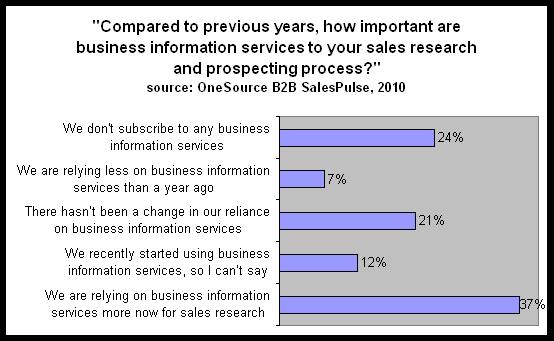
One anomaly in this data is sharply increasing reliance on external business information services. Twelve percent of respondents said they had recently started using these services and a whopping 37% said they were relying on them more heavily. Just seven percent were relying on them less and only 24% are not using them at all. I see this as an acknowledgment by salespeople that outside resources can indeed make them more efficient, even if they still do the actual outbound prospecting themselves.


For what it’s worth, the survey (taken in December 2009) also found some optimism about future sales: 55% said their pipeline was significantly or somewhat better than last year, compared with 33% who said it was significantly or somewhat worse. But sales cycles are still growing: 59% said they were longer than last year vs. 16% saying they were shorter. Although I wouldn’t read too much into such a small survey, this is at least consistent with the hypothesis that there’s a long-term trend towards lengthier, more complicated sales cycles that will continue even once the economy recovers.

Altogether, the results reinforce the conventional wisdom that marketers need to work closely with sales departments to ensure they are delivering qualified leads and that sales people recognize this. Longer-term projects such as lead nurturing and branding are harder to tie to specific sales revenues, but marketers must trace this connection to justify their funding.
Read More
Posted in demand generation, lead management, marketing sales alignment | No comments

Wednesday, 14 April 2010

SAS, Unica and smartFocus Add Social Media Features

Posted on 18:06 by Unknown
Summary: major consumer-oriented marketing automation vendors have all added some type of social media capabilities. But some focus on monitoring conversations while others help marketers send more messages. Be sure you know which you're getting.

On Monday, marketing automation vendors SAS and Unica both announced new social media capabilities. SAS provided quite a bit of detail while Unica did not, so I can’t compare the two announcements in depth. [Unica provided additional detail after this post was written.] But combined with a social network marketing announcement in February from smartFocus and Alterian's acquisition of social media monitoring system Techrigy last July, all major consumer-oriented marketing automation vendors have now added some flavor of social media marketing to their systems.

What’s really interesting is how widely those flavors vary.

- Techrigy lets marketers and service departments monitor, analyze and respond to comments in social media. See my discussion last July for details.

- SAS's new solution has analytical functions similar to Techrigy, including conversation monitoring and capture, content classification by topic and sentiment, drill-down to individual documents, influence measurement, and dashboards. But it doesn’t seem to include the case management features that a publicity or service department would use to interact with individuals.

- smartFocus aims not to monitor general social media activity but to measure the influence of individuals. Although the press release is short on details, the company told me that what it's really providing is a “share to social” option for system-generated emails. This lets smartFocus track how each recipient shares the item, identify Web visitors who clicked on the shared item, and collect the behaviors of those visitors. This data is linked back to the original recipient, so smartFocus can measure the activity each recipient has generated and profile that recipient's responders. Although the approach is far from comprehensive – it only tracks items that the smartFocus sent and the recipient shared – it does tie those activities to hard metrics such as purchases. It is quite different from calculating influence by counting followers or content reuse, which are the more conventional approaches to social media measurement.

- Unica announced several enhancements to its flagship Enterprise system, of which three had no particular social media focus: adding data capture forms to emails; adding personalization to Web sites via page tags; and a new graphical interface for its event-detection system. A fourth item, incorporating data from social media Web sites in the Web analytics solution, is useful but not ground-breaking. The only substantial new social media addition is Unica’s own “share to social” option, which the company confirms does not link shared items back to the original sharer as does smartFocus.

If there’s a lesson in all this, it’s that “social media solution” is far from a simple check box on your requirements list. Vendor solutions differ widely and will continue to vary for quite some time. SAS and Alterian chose to start with monitoring and measurement, while Unica and smartFocus jumped right into messaging. This nicely illustrates a similar split among marketers in choosing which to do first. Many recognize the need for measurement but can't resist the lure of sending messages that will generate immediate response. But even if you start with a messaging solution, be sure to add monitoring as quickly as possible. I suspect that most firms will find that the information they gather from social media is ultimately more valuable than the relatively small amount of business they gain from social media directly.
Read More
Posted in demand generation marketing automation, social media measurement | No comments

Monday, 5 April 2010

VisualIQ Measures Marketing Impacts Across All Channels

Posted on 11:54 by Unknown
Summary: VisualIQ combines customer-level transactions and contact history with traditional aggregate data to produce better marketing performance measurement. It hasn't solved the problem of identifying the same customer across channels, but it's trying.

I was going to start this post by writing that last-click attribution has recently come under fire, but the first Google hit on the topic brings up a study from 2007. So maybe the criticism isn’t particularly new. But the fact remains that, now more than ever, marketers are trying to measure the impact of all contacts on customer behavior.

Broadly speaking, the problem is attacked in two ways. One, most common among consumer goods manufacturers and others who do not sell directly to their customers, uses aggregated data in marketing mix models to find correlations between marketing efforts and total sales. The other, favored by banks, retailers, communications providers and others who do sell directly to known buyers, assesses the impact of each contact with specific individuals. Last-click attribution is a particular challenge for online marketers because they fall between these two situations: they can often identify their buyers but not trace their full contact history.

VisualIQ, founded in 2005 as Connexion.a, proposes to straddle these worlds by combining aggregate-level models with customer-specific contact history. They haven’t found a magic bullet: like everyone else, VisualIQ tracks online customers through cookies, with all the limits that implies. But VisualIQ strives to make the best use of what’s available by unifying data from as many online campaigns as possible, linking cookies with online transactions, and then linking online transactions to offline identities.

This approach offers some general advantages and two specific capabilities. The general advantages come from assembling all advertising and customer transaction information in one database. This allows VisualIQ to analyze campaign results, do whatever identity matching is possible, and to isolate the impact of source, contact frequency, demographics, location and other variables. VisualIQ, a hosted service, has invested heavily in technology to analyze massive data sets along such dimensions.

The first specific capability is relating pre-purchase contacts to actual purchases for individual customers, thus moving beyond last-click attribution. Although this is subject to the limits of cookie-based tracking, VisualIQ does what it can to build a unified identity by sharing the same cookie IDs across as many online channels as possible. The second capability is building mix models with data from actual customer contacts instead of market-level estimates or surveys. VisualIQ says it has found this yields more accurate results than traditional information.

This is all good stuff and VisualIQ has packaged it nicely in a tiered set of offerings. These range from campaign-level reporting to customer-based insights to predictive modeling and simulation, with prices for the simplest system starting as low as $5,000 to $10,000 per month. The company has had considerable success, counting major banks, retailers, and communications firms as clients. Note that these are all industries that sell to their customers directly.

But VisualIQ’s specific offerings are just part of the story. What’s really important is setting explicit goals of linking identities across channels and measuring cross-channel marketing impacts. These are arguably the core challenges in marketing measurement today. This focus has led VisualIQ to look for alternatives to cookies and to use existing methods to combine online and offline information for the same person.

The company is also seeking to make it easier to apply its results. Today, it basically generates reports that suggest better media allocations and advertising contents. But it is working to automatically feed those findings as rules into execution systems such as ad servers and ad exchanges. This brings marketers closer to the ultimate goal of self-optimizing programs. Other vendors are also pursuing self-optimization, but VisualIQ promises the advantage of decisions based on data from all channels rather than a single channel or, heaven forbid, just the last click.
Read More
Posted in marketing analytics, marketing performance measurement, media mix models, self-optimizing systems | No comments

Monday, 29 March 2010

thinkAnalytics Helps Marketers Optimize Customer Treatments

Posted on 14:17 by Unknown
Summary: thinkAnalytics provides a robust decision engine to help make optimal recommendations across channels. Too bad more people don't use it.

As I mentioned in my post on PegaSystems’ acquisition of Chordiant, I’ve been planning for months to write about the thinkAnalytics recommendation system. The delay had nothing to do with any reservations about the product, which I find extremely impressive. It was more because I've been giving the topic low priority because the market for such systems seems to be moving slowly despite the clear benefits they provide.

The history of thinkAnalytics itself illustrates my point nicely. The company was founded in 1996 to offer K.wiz data mining software and had reached pretty much its current form by the early 2000’s. Indeed, the briefing slides the company showed me in mid-2009 were nearly identical its slides from 2007. The company also reported about twenty installations in both sessions. This isn’t to say that product itself has not evolved: it’s now up to version 8.0 and release notes on the company Web site show a steady stream of enhancements. But the fundamental approach has not changed.

This approach uses an “Intelligent Enterprise Server” to connect company touchpoints and data sources to thinkAnalytics’ data mining, recommendations and business rules engines. That is, thinkAnalytics sits outside of the individual touchpoint systems, allowing it to deliver consistent recommendations across all channels. These recommendations in turn are based information from on all data sources, not only those captured within a particular touchpoint system.

The advantages of consistent treatment and access to all company are self-evident. Of course, they do require identifying individuals across channels, so that, say, behavior during Web visits is linked to behavior at a call center. thinkAnalytics doesn’t directly solve this problem, but can make use of whatever linkages the company has built elsewhere. Its most common applications, churn reduction for telecommuncations companies and content recommendations for video-on-demand services, are in situations where customers explicitly identify themselves, so this is not an issue.

The technical hub of thinkAnalytics is the enterprise server, which needs to handle traffic among touchpoints, data sources, and the analytical components. The main issues with such servers are flexibility and scalability. thinkAnalytics addresses these by deploying a component-based architecture that lets it connect with virtually any external systems and can easily be distributed across platforms and servers to scale as necessary. The company says existing installations have scaled to thousands of decisions per second. Its client list is weighted towards very large firms – Vodafone, Virgin Media, Sky, orange, Lloyds TSB, and Alcatel-Lucent among them – who require this sort of volume.

But while the server may be the technical hub of the system, its heart is the analytic components: data mining, recommendations and rules engines. Data mining includes a wide variety of predictive modeling and data visualization capabilities, some fully automated, which feed into the recommendations themselves. The system can also import external predictive models from vendors such as SAS and SPSS. The system includes several specialized capabilities related to video content selection, including automated text analysis to create metadata and classify new content; capture of user preference ratings; handling of social recommendations; maintenance of personal profiles; and user-initiated search. The component-based architecture makes it relatively easy for thinkAnalytics to add specialized features in general, so the system could be adopted to other applications fairly easily.

The rules engine complements the recommendation rankings by letting managers apply constraints such as limiting the number of recommendations within any particular category. However, the system doesn’t provide sophisticated optimization tools, so it’s still up to marketers to manually discover the most effective rule sets.

Although the multi-channel capability of thinkAnalytics is highly impressive, the vendor says that most clients start using it in a single channel and add others a year or two later. This suggests that clients are primarily interested in the quality of the recommendations, and just secondarily in the cross-channel treatment coordination. thinkAnalytics reports that its telecommuncations clients have seen churn rates of 20% drop to 12%, while video-on-demand clients have increased sales between 30% and 55%.

Pricing for thinkAnalytics real-time components depends on the nature of the application. Factors can include the channels and applications, number of data mining users, and customer volume. A minimum installation for the recommendation engine starts around $250,000. The system is licensed for on-premise operation by the client.

The four components of thinkAnalytics (predictive modeling, recommendations, rules and a server to connect with the outside world) make it the very model of what is sometimes called a “decision engine”. As I noted in the Chordiant post mentioned earlier, most companies use the decisioning capabilities built into their touchpoint systems rather than buying a stand-alone product. But it’s still worth keeping the model in mind when assessing whether your touchpoint systems’ capabilities are truly adequate.
Read More
Posted in customer experience management, decision engines, demand generation marketing automation, optimization | No comments

Monday, 22 March 2010

ClickSquared System Combines Marketing Database, Campaign Management and Multi-Channel Message Delivery

Posted on 17:32 by Unknown
Summary: ClickSquared is marketing services agency that, unlike most of its peers, has built its own marketing automation system. The main advantage is tight integration of database build, campaign management and message delivery. The vendor has just officially launched its system, which should meet the needs of most mid-tier consumer marketers.

In a post last week, I casually described ClickSquared as a vendor delivering multi-channel messages for external campaign management systems. This was not wholly accurate. Although integrated multi-channel delivery is indeed a key differentiator for ClickSquared, the firm also offers its own campaign management system, called “Click 3G”. In fact, Click 3G was officially launched last week, although the company has been migrating clients to the platform since Fall 2008.

The more important clarification is that ClickSquared is a marketing services agency, offering database management, campaign development, creative, execution and analysis. The company got its start in 1999 as a direct mail house specializing in overnight execution of trigger marketing programs. Since then it has added email and other services through acquisitions and internal expansion. It now offers a relationships relationships ranging from full-service to self-service, with a particular focus on full-service solutions for mid-tier businesses and on special programs for very large enterprises. It sends emails for about 85% of its 150 clients and maintains marketing databases for about half of them.

In other words, ClickSquared competes with firms like Epsilon, Merkle and Acxiom for enterprise clients, and with a host of smaller firms for mid-tier clients. It also competes to some degree with email providers like Responsys, ExactTarget and InfoGroup YesMail, which are themselves expanding into other channels. (Apologies to all for over-simplification. Properly identifying the overlapping spheres of industry competitors would take a post of its own.)

One feature that stands out about ClickSquared is its choice to build its own campaign management system. This contrasts with the vast majority of marketing services agencies, which rely on industry-standard products such as Unica and Alterian. The fundamental argument for using industry-standard software is that continuously updating a home-grown system costs too much for most marketing services vendors, who can’t spread the expense across as many clients as a dedicated software company. Nor is software development a core competency of many marketing services agencies. Ultimately, this line of reasoning concludes, marketing services agencies compete on database management, analytics, marketing strategy and client service, so software is a poor investment for their necessarily limited resources.

To put matters in historical perspective, most big marketing services agencies did create their own campaign management systems when the category first developed in the 1990’s. But once satisfactory third-party products became widely available, the big firms largely dropped their in-house products. So it’s intriguing that ClickSquared (and a few other firms including Entiera , which I reviewed last July) have again chosen to build their own.

It’s much too soon to consider this a trend, but perhaps the cost/value relationship has shifted back in favor of in-house systems. The logic would be something like this: the prices of commercial systems haven't change, while the cost of building in-house systems has fallen because the requirements are well understood and developers can take advantage of third-party components and agile development methods. Thus, in-house development is relatively more attractive.

But in talking with ClickSquared (and Entiera, for that matter), I hear slightly a different story. It’s true that they avoid hefty license fees by using their own software. But main savings seems to come from integrating several capabilities, including customer data integration, message delivery and reporting, in addition to campaign management itself. This reduces both the total software cost and the labor needed to combine the separate systems. For example, ClickSquared says it can deliver a new marketing database in one to three months, compared with six months or more using third party systems.

Of course, an in-house system must still meet business needs for the savings to be worthwhile. Part of the reason that ClickSquared targets Click 3G at mid-tier companies is that their needs are somewhat less complex than enterprise marketers. That said, the system offers a respectable set of capabilities.

- Customer data can be loaded via API posts or self-service file uploads. The system provides automated data cleansing and customer matching capabilities. It can also gather data with an advanced email survey tool that supports for dynamic questions (i.e., questions change based on previous responses) and complex question types such as rankings and allocations. Marketing content can be uploaded and edited within the system and then shared across campaigns.

- Analytics are largely handled outside the system. These is no built-in predictive modeling, although scores can be imported and used as variables into segment definitions and business rules. The system does provide its own Web analytics module, or it can import data from Omniture or Coremetrics. ClickSquared captures online response using standard link tracking and can generate heat map reports showing how often different links were clicked within an email or Web form. Users can execute custom attribution rules during their database build.

- Campaigns are based on business rules. These can be executed in batch or triggered by events posted to the system API in real time. The rules can consider file segmentation, offer selection, channel preferences and limits on contact frequency when selecting messages. Click 3G also supports “distributed marketing” campaigns that allow users such as branch offices to execute predefined programs by setting a limited number of parameters. Campaign outputs can include dynamically-customized content for direct mail, email, and mobile (SMS) messages, as well as messages sent to CRM systems via an API.

- Message delivery for email is handled directly by ClickSquared, which helps to manage ISP relationships, ensures compliance with anti-spam regulations, and can spread large blasts over time. The system provides similar services for wireless (SMS) messages, although (like most marketing service vendors) it works with a third party to integrate with carriers. For direct mail, ClickSquared can handle preprocessing such as NCOA and then deliver a file of printer-ready personalized PDFs. Although campaign manager-to-email integration is more common today than when ClickSquared began, its multi-channel integration is still an advantage.

- The system also provides several “Web 2.0” options. Most notable is “clickShare”, which lets users register and then upload, share and comment on materials in an online forum. Other applications support referrals, mapping mash-ups and product ratings. Activities in these applications are fed into the marketing database, where they can be used for segmentation and triggers.

Click 3G lacks some refinements of the main commercial campaign management products, such as embedded predictive modeling and detailed project management. The vendor argues that its mid-tier clients don’t necessarily need such features, or at least need them less than tightly integrated database building and message delivery. Click 3G’s largest installations are currently in 15 to 20 million customer range, firmly within mid-tier territory.

Pricing for ClickSquared is based on the combination of professional and technical services used by each client. For Click 3G, factors include database size, channels used, message volume and system modules. A self-service client with 50,000 customers and 100,000 emails per month would pay $1,500 per month for the system. A client with two million customers and a proportionate mix of email, direct mail, text messages, surveys and social content would pay $15,000 per month. Clients commit to a contract of one year or longer.
Read More
Posted in campaign management, demand generation marketing automation, marketing services providers, marketing software, mid-tier marketing systems | No comments

Friday, 19 March 2010

Real Examples of Social Media ROI

Posted on 13:22 by Unknown
Summary: some published examples of "hard" ROI from social media.

As part of the preparation for next Tuesday’s Webinar with 1to1 Media and Neolane (register here), I poked around for some concrete examples of ROI from social media. Here’s what I found.

Socialnomics blog by Erik Qualman offers a dynamic video with 33 “salient examples and data points” about social media ROI. Some are pretty vague but the concrete ones include:

- Wine TV Library gained 1,800 new customers from Twitter

- Lenovo attributed a 20% reduction in call center activity to use of a community website for answers

- Burger King received 32 million media impressions from a Facebook app promotion costing less than $50,000

- Genius.com reports that 24% of its social media leads convert to sales opportunities

- Moonfruit sales of its Web hosting service increased 20% on a $15,000 social media investment

Jacob Morgan cites a Computerworld article describing how online community platform vendor Reality Digital generated 72 leads over the first three months of its social media project, at a cost of roughly $9,000. The company expected this to yield at least one sale which would cover the entire annual cost of the program.

ReadWriteWeb reports “a Cisco study in 2004 found that 43% of visits to online support forum are in lieu of opening up a support case through standard methods.”

Socialtext corporate blog cites an estimate by TransUnion CTO John Parkinson that his $50,000 investment in Socialtext has avoided $2.5 million in tech spending by helping users share ideas on how to solve their problems more cheaply.

10e20 corporate blog gives three examples of social media conversion:

- response to a LinkedIn group query became a 10e20 client

- a "couple of hours per week" spent social bookmarking the contents of an online magazine at StumbleUpon and other sites drove “10’s of thousands of visitors as opposed to hundreds”, resulting in much higher ad pay-per-click ad revenue

- major national fashion brand invested the equivalent of "one mid-level employee’s salary" to run a dedicated social media presence, yielding 75,000 fans and followers and “several hundred thousand dollars in new sales in three months of marketing” as well as reaching a new audience, improving public relations and customer service, and gaining feedback for product development

HubSpot's The State of Inbound Marketing 2010 survey found that 41% to 46% of the companies using Twitter, LinkedIn, Facebook or a company blog had acquired a customer from that channel.

Predictive Marketing Blog by Bob Hodgson
reported that eight Tweets by a high tech conference with 350 followers generated 10 completed registrations worth $15,000.

I also found plenty of insightful content that doesn’t include specific numbers. In general, there are two schools of thought on social media ROI: some think it really must be tied to revenue and profits to be meaningful; others argue just as passionately that different measures are appropriate depending on the program objective.

Truth be told, my heart is with the “revenue and profits” school. But I suspect it may be too simplistic, so I do accept alternative measures as a valid alternative. The problem with tying social media to "hard" ROI is this often relies on complex intermediate calculations, which are subjective in themselves. That being the case, alternative measures are not necessarily less valid; it depends on the details. (Fallacy alert: just because neither is perfect, it doesn’t follow that both are equally bad).

In any case, here are a few discussions I found particularly worthwhile:

A SlideShare presentation from Peashoot (a social media campaign manager) listing different metrics for different campaigns. These are good examples even though there are no actual results.

An eConsultancy blog post sharing comments on social media ROI from a collection of British experts.

Another eConsultancy post listing ten specific ways to measure social media success.
Read More
Posted in marketing measurement, social media roi | No comments
Newer Posts Older Posts Home
Subscribe to: Posts (Atom)

Popular Posts

  • 4 Marketing Tech Trends To Watch in 2014
    I'm not a big fan of year-end summaries and forecasts, mostly because I produce summaries and forecasts all year round.  But I pulled to...
  • Infer Keeps It Simple: B2B Lead Scores and Nothing Else
    I’ve nearly finished gathering information from vendors for my new study on Customer Data Platform systems and have started to look for patt...
  • OfficeAutoPilot: Simple, Powerful, Low Cost Demand Generation for Small Business
    My personal definition of demand generations systems (see Introduction to Demand Generation Systems from the Raab Guide site) explicitly st...
  • Gainsight Gives Customer Success Managers a Database of Their Own
    I had a conversation last week with a vendor whose pitch was all about providing execution systems with a shared database that contains a un...
  • Demand Generation Usability Scores - Part 3
    Usability Items for Complex Marketing Programs (note: this is a slightly revised version of the original post, reflecting vendor feedback....
  • eBay Offers $2.4 Billion for GSI Commerce: More Support for Marketing Automation
    eBay ’s $2.4 billion offer for e-commerce services giant GSI Commerce has been described largely in terms of helping eBay to compete with ...
  • Demand Generation Implementation -- Take My Survey, Please!
    Update - 4/23/09: I have some preliminary results, but would still like more responses. Click here to take survey . One result of interest: ...
  • Pegasystems Buys Chordiant to Help Coordinate Customer Treatment Decisions
    Summary: Pegasystems purchased Chordiant last week, adding a sophisticated cross-channel decision engine to its stable. It's been hard f...
  • First Look at New Marketo Release
    I’m going to diverge just slightly from my current obsession with usability to talk about a conversation I had today with Marketo President...
  • thinkAnalytics Helps Marketers Optimize Customer Treatments
    Summary: thinkAnalytics provides a robust decision engine to help make optimal recommendations across channels. Too bad more people don...

Categories

  • [x+1]
  • 1010Data
  • 2009 trends
  • 2010 predictions
  • 2011 predictions
  • 2013 marketing automation revenues
  • 2014 predictions
  • account data in marketing systems
  • acquisitions
  • acquistions
  • act-on software
  • active conversion
  • activeconversion
  • acxiom
  • ad agencies
  • ad servers
  • adam needles
  • adobe
  • adometry
  • advertising effectiveness
  • advocate management
  • affiliate marketing
  • agilone
  • aida model
  • aimatch
  • algorithmic attribution
  • alterian
  • analysis systems
  • analytical database
  • analytical databases
  • analytical systems
  • analytics tools
  • app exchange
  • app marketplace
  • application design
  • aprimo
  • are
  • artificial intelligence
  • ascend2
  • asset management
  • assetlink
  • atg
  • attribution analysis
  • attribution models
  • automated decisions
  • automated dialog
  • automated modeling
  • autonomy
  • b2b demand generation
  • b2b demand generation systems
  • b2b email marketing benchmarks
  • b2b lead scoring
  • b2b marketing
  • b2b marketing automation
  • b2b marketing automation industry consolidation
  • b2b marketing automation industry growth rate
  • b2b marketing automation revenues
  • b2b marketing automation systems
  • b2b marketing automation vendor rankings
  • b2b marketing data
  • b2b marketing industry consolidation
  • b2b marketing strategy
  • b2b marketing system comparison
  • b2c marketing automation
  • b2c marketing automation vendors
  • balanced scorecard
  • balihoo
  • barriers to marketing success
  • barry devlin
  • beanstalk data
  • behavior detection
  • behavior identification
  • behavior targeting
  • behavioral data
  • behavioral targeting
  • big data
  • birst
  • bislr
  • blogging software
  • brand experience
  • brand marketing
  • business intelligence
  • business intelligence software
  • business intelligence systems
  • business marketing
  • businses case
  • callidus
  • campaign flow
  • campaign management
  • campaign management software
  • causata
  • cdi
  • cdp
  • channel management
  • channel marketing
  • channel partner management
  • chordiant
  • cio priorities
  • clickdimensions
  • clicksquared
  • clientxclient
  • cloud computing
  • cmo surveys
  • cms
  • collaboration software
  • column data store
  • column-oriented database
  • columnar database
  • community management
  • compare marketing automation vendors
  • compiled data
  • complex event processing
  • consumer marketing
  • contact center systems
  • content aggregation
  • content distribution
  • content grazing
  • content management
  • content marketing
  • content matrix
  • content recommendations
  • content selections
  • content syndication
  • context automation
  • conversen
  • coremetrics
  • crm
  • crm integration
  • CRM lead scores
  • crm software
  • crm systems
  • crmevolution
  • cross-channel marketing
  • crowd sourcing
  • custom content
  • custom media
  • customer database
  • customer analysis
  • customer data
  • customer data integration
  • customer data management
  • customer data platform
  • customer data platforms
  • customer data quality
  • customer data warehouse
  • customer database
  • customer experience
  • customer experience management
  • customer experience matrix
  • customer information
  • customer management
  • customer management software
  • customer management systems
  • customer metrics
  • customer relationship management
  • customer satisfaction
  • customer success
  • customer support
  • cxc matrix
  • dashboards
  • data analysis
  • data cleaning
  • data cleansing
  • data enhancement
  • data integration
  • data loading
  • data mining
  • data mining and terrorism
  • data quality
  • data transformation tools
  • data visualization
  • data warehouse
  • database management
  • database marketing
  • database marketing systems
  • database technology
  • dataflux
  • datallegro
  • datamentors
  • david raab
  • david raab webinar
  • david raab whitepaper
  • day software
  • decision engiens
  • decision engines
  • decision management
  • decision science
  • dell
  • demand generation
  • demand generation implementation
  • demand generation industry
  • demand generation industry growth rate
  • demand generation industry size
  • demand generation industry trends
  • demand generation marketbright
  • demand generation marketing automation
  • demand generation software
  • demand generation software revenues
  • demand generation systems
  • demand generation vendors
  • demandforce
  • digiday
  • digital marketing
  • digital marketing systems
  • digital messaging
  • distributed marketing
  • dmp
  • dreamforce
  • dreamforce 2012
  • dynamic content
  • ease of use
  • ebay
  • eglue
  • eloqua
  • eloqua10
  • elqoua ipo
  • email
  • email marketing
  • email service providers
  • engagement engine
  • enteprise marketing management
  • enterprise decision management
  • enterprise marketing management
  • enterprise software
  • entiera
  • epiphany
  • ETL
  • eTrigue
  • event detection
  • event stream processing
  • event-based marketing
  • exacttarget
  • facebook
  • feature checklists
  • flow charts
  • fractional attribution
  • freemium
  • future of marketing automation
  • g2crowd
  • gainsight
  • Genius.com
  • genoo
  • geotargeting
  • gleanster
  • governance
  • grosocial
  • gsi commerce
  • high performance analytics
  • hiring consultants
  • hosted software
  • hosted systems
  • hubspot
  • ibm
  • impact of internet on selling
  • importance of sales execution
  • in-memory database
  • in-site search
  • inbound marketing
  • industry consolidation
  • industry growth rate
  • industry size
  • industry trends
  • influitive
  • infor
  • information cards
  • infusioncon 2013
  • infusionsoft
  • innovation
  • integrated customer management
  • integrated marketing management
  • integrated marketing management systems
  • integrated marketing systems
  • integrated systems
  • intent measurement
  • interaction advisor
  • interaction management
  • interestbase
  • interwoven
  • intuit
  • IP address lookup
  • jbara
  • jesubi
  • king fish media
  • kwanzoo
  • kxen
  • kynetx
  • large company marketing automation
  • last click attribution
  • lead capture
  • lead generation
  • lead management
  • lead management software
  • lead management systems
  • lead managment
  • lead ranking
  • lead scoring
  • lead scoring models
  • leadforce1
  • leadformix
  • leading marketing automation systems
  • leadlander
  • leadlife
  • leadmd
  • leftbrain dga
  • lifecycle analysis
  • lifecycle reporting
  • lifetime value
  • lifetime value model
  • local marketing automation
  • loopfuse
  • low cost marketing software
  • low-cost marketing software
  • loyalty systems
  • lyzasoft
  • makesbridge
  • manticore technology
  • mapreduce
  • market consolidation
  • market software
  • market2lead
  • marketbight
  • marketbright
  • marketgenius
  • marketing analysis
  • marketing analytics
  • marketing and sales integration
  • marketing automation
  • marketing automation adoption
  • marketing automation benefits
  • marketing automation consolidation
  • marketing automation cost
  • marketing automation deployment
  • marketing automation features
  • marketing automation industry
  • marketing automation industry growth rate
  • marketing automation industry trends
  • marketing automation market share
  • marketing automation market size
  • marketing automation maturity model
  • marketing automation net promoter score. marketing automation effectiveness
  • marketing automation pricing
  • marketing automation software
  • marketing automation software evaluation
  • marketing automation success factors
  • marketing automation system deployment
  • marketing automation system evaluation
  • marketing automation system features
  • marketing automation system selection
  • marketing automation system usage
  • marketing automation systems
  • marketing automation trends
  • marketing automation user satisfaction
  • marketing automation vendor financials
  • marketing automation vendor selection
  • marketing automation vendor strategies
  • marketing automion
  • marketing best practices
  • marketing cloud
  • marketing content
  • marketing data
  • marketing data management
  • marketing database
  • marketing database management
  • marketing education
  • marketing execution
  • marketing funnel
  • marketing integration
  • marketing lead stages
  • marketing management
  • marketing measurement
  • marketing mix models
  • marketing operating system
  • marketing operations
  • marketing optimization
  • marketing performance
  • marketing performance measurement
  • marketing platforms
  • marketing priorities
  • marketing process
  • marketing process optimization
  • marketing resource management
  • marketing return on investment
  • marketing ROI
  • marketing sales alignment
  • marketing service providers
  • marketing services
  • marketing services providers
  • marketing skills gap
  • marketing software
  • marketing software evaluation
  • marketing software industry trends
  • marketing software product reviews
  • marketing software selection
  • marketing software trends
  • marketing softwware
  • marketing suites
  • marketing system architecture
  • marketing system evaluation
  • marketing system ROI
  • marketing system selection
  • marketing systems
  • marketing technology
  • marketing tests
  • marketing tips
  • marketing to sales alignment
  • marketing training
  • marketing trends
  • marketing-sales integration
  • marketingpilot
  • marketo
  • marketo funding
  • marketo ipo
  • master data management
  • matching
  • maturity model
  • meaning based marketing
  • media mix models
  • message customization
  • metrics
  • micro-business marketing software
  • microsoft
  • microsoft dynamics crm
  • mid-tier marketing systems
  • mindmatrix
  • mintigo
  • mma
  • mobile marketing
  • mpm toolkit
  • multi-channel marketing
  • multi-language marketing
  • multivariate testing
  • natural language processing
  • neolane
  • net promoter score
  • network link analysis
  • next best action
  • nice systems
  • nimble crm
  • number of clients
  • nurture programs
  • officeautopilot
  • omnichannel marketing
  • omniture
  • on-demand
  • on-demand business intelligence
  • on-demand software
  • on-premise software
  • online advertising
  • online advertising optimization
  • online analytics
  • online marketing
  • open source bi
  • open source software
  • optimization
  • optimove
  • oracle
  • paraccel
  • pardot
  • pardot acquisition
  • partner relationship management
  • pay per click
  • pay per response
  • pedowitz group
  • pegasystems
  • performable
  • performance marketing
  • personalization
  • pitney bowes
  • portrait software
  • predictive analytics
  • predictive lead scoring
  • predictive modeling
  • privacy
  • prospect database
  • prospecting
  • qliktech
  • qlikview
  • qlikview price
  • raab guide
  • raab report
  • raab survey
  • Raab VEST
  • Raab VEST report
  • raab webinar
  • reachedge
  • reachforce
  • real time decision management
  • real time interaction management
  • real-time decisions
  • real-time interaction management
  • realtime decisions
  • recommendation engines
  • relationship analysis
  • reporting software
  • request for proposal
  • reseller marketing automation
  • response attribution
  • revenue attribution
  • revenue generation
  • revenue performance management
  • rfm scores
  • rightnow
  • rightwave
  • roi reporting
  • role of experts
  • rule-based systems
  • saas software
  • saffron technology
  • sales automation
  • sales best practices
  • sales enablement
  • sales force automation
  • sales funnel
  • sales lead management association
  • sales leads
  • sales process
  • sales prospecting
  • salesforce acquires exacttarget
  • salesforce.com
  • salesgenius
  • sap
  • sas
  • score cards
  • search engine optimization
  • search engines
  • self-optimizing systems
  • selligent
  • semantic analysis
  • semantic analytics
  • sentiment analysis
  • service oriented architecture
  • setlogik
  • setlogik acquisition
  • silverpop
  • silverpop engage
  • silverpop engage b2b
  • simulation
  • sisense prismcubed
  • sitecore
  • small business marketing
  • small business software
  • smarter commerce
  • smartfocus
  • soa
  • social campaign management
  • social crm
  • social marketing
  • social marketing automation
  • social marketing management
  • social media
  • social media marketing
  • social media measurement
  • social media monitoring
  • social media roi
  • social network data
  • software as a service
  • software costs
  • software deployment
  • software evaluation
  • software satisfaction
  • software selection
  • software usability
  • software usability measurement
  • Spredfast
  • stage-based measurement
  • state-based systems
  • surveillance technology
  • sweet suite
  • swyft
  • sybase iq
  • system deployment
  • system design
  • system implementation
  • system requirements
  • system selection
  • tableau software
  • technology infrastructure
  • techrigy
  • Tenbase
  • teradata
  • test design
  • text analysis
  • training
  • treehouse international
  • trigger marketing
  • twitter
  • unica
  • universal behaviors
  • unstructured data
  • usability assessment
  • user interface
  • vendor comparison
  • vendor evaluation
  • vendor evaluation comparison
  • vendor rankings
  • vendor selection
  • vendor services
  • venntive
  • vertica
  • visualiq
  • vocus
  • vtrenz
  • web analytics
  • web contact management
  • Web content management
  • web data analysis
  • web marketing
  • web personalization
  • Web site design
  • whatsnexx
  • woopra
  • youcalc
  • zoho
  • zoomix

Blog Archive

  • ▼  2013 (55)
    • ▼  December (4)
      • 4 Marketing Tech Trends To Watch in 2014
      • Webinar, December 18: How Marketers Can (Finally) ...
      • Woopra Grows from Web Analytics to Multi-Source Cu...
      • Optimove Helps Optimize Customer Retention (And, Y...
    • ►  November (5)
    • ►  October (4)
    • ►  September (3)
    • ►  August (5)
    • ►  July (5)
    • ►  June (5)
    • ►  May (6)
    • ►  April (6)
    • ►  March (1)
    • ►  February (6)
    • ►  January (5)
  • ►  2012 (56)
    • ►  December (4)
    • ►  November (3)
    • ►  October (6)
    • ►  September (4)
    • ►  August (7)
    • ►  July (3)
    • ►  June (4)
    • ►  May (5)
    • ►  April (3)
    • ►  March (4)
    • ►  February (8)
    • ►  January (5)
  • ►  2011 (74)
    • ►  December (9)
    • ►  November (8)
    • ►  October (6)
    • ►  September (5)
    • ►  August (5)
    • ►  July (3)
    • ►  June (6)
    • ►  May (5)
    • ►  April (6)
    • ►  March (8)
    • ►  February (7)
    • ►  January (6)
  • ►  2010 (75)
    • ►  December (9)
    • ►  November (9)
    • ►  October (5)
    • ►  September (6)
    • ►  August (7)
    • ►  July (3)
    • ►  June (6)
    • ►  May (9)
    • ►  April (4)
    • ►  March (6)
    • ►  February (6)
    • ►  January (5)
  • ►  2009 (96)
    • ►  December (2)
    • ►  November (4)
    • ►  October (5)
    • ►  September (9)
    • ►  August (7)
    • ►  July (16)
    • ►  June (9)
    • ►  May (5)
    • ►  April (11)
    • ►  March (11)
    • ►  February (11)
    • ►  January (6)
  • ►  2008 (59)
    • ►  December (6)
    • ►  November (3)
    • ►  October (8)
    • ►  September (1)
    • ►  August (5)
    • ►  July (8)
    • ►  June (5)
    • ►  May (5)
    • ►  April (6)
    • ►  March (3)
    • ►  February (3)
    • ►  January (6)
  • ►  2007 (84)
    • ►  December (4)
    • ►  November (6)
    • ►  October (6)
    • ►  September (1)
    • ►  August (4)
    • ►  July (7)
    • ►  June (16)
    • ►  May (20)
    • ►  April (20)
Powered by Blogger.

About Me

Unknown
View my complete profile